
ABAT's story becomes clearer when two opportunities are kept apart. Recycling has reported commercial activity to examine; Tonopah needs its own development and funding case. Combining them into one optimistic headline hides the questions that matter to shareholders.
Reading note: Presentation refreshed October 30, 2026. Original publication: 2026-10-22 (UTC). Figures, targets and company claims retain their original evidence dates; this is not a new verification or a live-price update.
Key takeaways
- Revenue is operating evidence. Growth does not by itself establish durable GAAP margins or free cash flow.
- Adjusted is not GAAP. The reported gross-profit milestone must be read alongside the corresponding GAAP result.
- Permission is not a sale. An export-license ceiling is not booked revenue or cash collected.
- Projects have funding gates. Tonopah approvals, grants, cost-sharing and construction must be evaluated separately from recycling.
American Battery Technology Company (NASDAQ: ABAT), commonly branded ABTC, offers exposure to two related but economically different businesses: recovering materials from used lithium-ion batteries and developing a primary lithium mining and refining project in Nevada. The first has reported commercial revenue. The second remains a development-stage proposition requiring further permitting, funding and construction.
As of this review on 22 October 2026, the central research question is whether growing recycling activity can become a durable cash-generating business without placing excessive funding demands on shareholders. Tonopah Flats adds potential long-term value, but a resource, a government milestone and a completed operating asset are not interchangeable.
What has changed in the business
ABTC's 14 September 2026 results release, covering the fiscal year ended 30 June 2026, reported revenue of $21.7 million, up 407% from $4.3 million in FY2025. Management attributed the increase to higher recycling throughput, additional byproduct production and improved product pricing.
That is substantive operating progress, not simply a new partnership headline. However, the financial quality of that growth needs equal attention: reported cost of goods sold was $24.8 million, leaving a GAAP gross loss of $3.1 million for the full year.
The same release reported positive adjusted gross profit of $1.7 million after excluding depreciation and stock-based compensation from cost of goods sold. The distinction matters because a positive adjusted measure does not establish GAAP profitability, net income or positive operating cash flow.
Bull evidence: growth and a stronger reported cash balance
$21.7M
FY2026 revenueIssuer-reported sales for the year ended 30 June 2026, compared with $4.3 million in FY2025. The reported 407% increase is from a relatively small base and should not be extrapolated indefinitely.
$1.7M
Adjusted gross profitA positive non-GAAP result after removing depreciation and stock-based compensation from cost of goods sold. It is evidence of improvement on management's chosen measure, not proof of net profitability.
$49.5M
Cash at 30 June 2026The issuer reported an increase from $7.5 million a year earlier and no outstanding debt at the fiscal year-end. This is historical cash, not a verified cash balance on the publication date.
The constructive interpretation is that rising throughput may be spreading facility costs over more output. If that trend continues, the current recycling operation could become more economically resilient. The evidence still needs to progress from revenue growth to sustained GAAP margins and cash generation.
Bear evidence: adjusted progress is not self-funded growth
$3.1M loss
FY2026 GAAP gross resultReported revenue of $21.7 million was below $24.8 million of cost of goods sold. Gross loss is before corporate expenses and does not represent the full company-level loss.
Not established
Sustainable free cash flowPositive adjusted gross profit does not establish positive operating cash flow or free cash flow after capital spending. The current funding runway cannot be calculated from the headline cash figure alone.
The non-GAAP reconciliation removes approximately $3.7 million of depreciation and $1.1 million of stock-based compensation from cost of goods sold. Depreciation is not a current-period cash payment, but the underlying equipment still requires maintenance and eventual replacement. Stock compensation is also not a current cash operating payment, but it can have an economic cost for shareholders through dilution.
All figures in these evidence cards come from the company's FY2026 results release. They have not been independently reconciled to the complete Form 10-K in this review.
The $100 million export license is not $100 million of booked sales
On 1 October 2026, ABTC announced U.S. Department of Commerce Bureau of Industry and Security approval to export up to $100 million of recycled black mass under specified terms. Black mass is an intermediate material containing recoverable battery minerals; it is not equivalent to finished battery-grade chemicals.
The license is relevant because regulatory permission can preserve a route to buyers as export controls change. But an authorization ceiling is not an order book, a shipment forecast or a cash receipt. Actual economic value depends on customer orders, pricing, permitted destinations and terms, available material, logistics and payment collection.
Do not add $100 million to annual revenue or enterprise value merely because that amount appears in a headline. The useful follow-up evidence would be disclosed shipments, realized selling prices, margin contribution and collected proceeds.
Recycling and Tonopah should be evaluated separately
For recycling, the company describes its first commercial facility as having capacity of 20,000 tonnes per year and a planned second facility designed for approximately 100,000 tonnes annually. Those figures are facility capacity/design descriptions, not proof of actual annual processed tonnage, utilization or output sold.
The near-term questions are operational: how much material is processed, how much usable product is recovered, what customers pay, and how feedstock costs, yields, labour, logistics and working capital affect margins. A battery collection relationship is useful only if its volumes and economics support the plant.
Tonopah Flats is a different investment problem. It combines a lithium resource with a proposed mine and refinery. Its prospects depend on technical execution, environmental review, permits, construction financing, commissioning and the economics of future lithium production. Resource size alone is not evidence that a commercial project is fully funded or ready to operate.
Tonopah: a permitting milestone, not final approval
The company's 8 September 2026 announcement said the Bureau of Land Management had accepted the mine and refinery Plan of Operations. In that release, preparation of an Environmental Impact Statement and further federal, state and local requirements remained part of the path ahead.
Acceptance of a plan is meaningful progress through a process. It is not the same as all final permits, a positive final investment decision or a completed refinery. Similarly, FAST-41 coordination can improve visibility and interagency scheduling without eliminating environmental review requirements.
The release described a 5,000-tonne-per-year initial processing train and a potential 30,000-tonne-per-year build-out. These are proposed stages, not current production. This article does not assume that the September permitting status remains unchanged; subsequent government records and company filings need checking before relying on any development schedule.
Keep the different funding headlines separate
The FY2026 release described a reinstated $57.7 million DOE cooperative agreement for the first phase of the Tonopah lithium refinery. A separate June announcement described the associated first-phase project as a $115 million project. The project cost figure is not the size of the federal grant.
The company also describes a separate $150 million DOE grant supporting its second recycling facility. That is a different project from Tonopah. Neither headline should be treated as unrestricted cash already received or as proof that every company funding obligation is covered. Review the award conditions, eligible spending, required company contributions, reimbursement timing and remaining funding needs.
The September Tonopah release also references a $900 million Export-Import Bank letter of interest for expansion. A letter of interest is not an executed loan, a funding commitment or cash in the bank. The financing terms and conditions would need separate confirmation.
Grant-reinstatement source: https://americanbatterytechnology.com/press-release/american-battery-technology-company-wins-appeal-and-has-us-department-of-energy-grant-reinstated-for-115-million-project-for-commercial-scale-critical-mineral-lithium-refinery/
The main risks for ABAT shareholders
- Margin durability: commodity prices, feedstock economics, product mix and operating costs could offset the benefit of higher processing volumes.
- Financing and dilution: expanding recycling facilities and developing a mine/refinery can require substantial capital. Shareholders need to monitor actual equity issuance and fully diluted share count, not just management's project descriptions.
- Government-policy exposure: grants, export permissions and permitting processes have conditions and can change. Announced support does not remove commercial risk.
- Execution risk: planned capacity can be delayed, exceed its budget or operate below expected utilization and recovery rates.
- Lithium-price sensitivity: lower realized prices can weaken project economics even when demand for electrification grows over the long term.
- Revenue concentration and repeatability: determine whether large cleanup projects or particular customers account for an outsized share of sales, and whether the business can replace that work at attractive margins.
- Working-capital pressure: processing and shipping more material may consume cash before customers pay. Revenue growth can coexist with a worsening cash position.
- Small-company trading risk: thin liquidity, wide spreads and financing announcements can produce large price moves unrelated to steady progress in intrinsic business value.
These are risks to investigate, not claims that every adverse outcome has occurred. In particular, this review does not establish a specific future capital raise or a current liquidity shortfall.
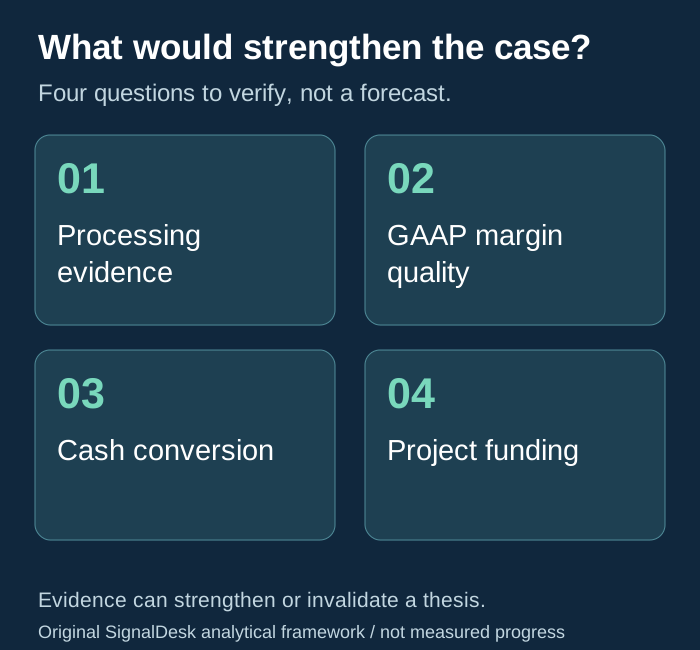
What would strengthen the constructive case
- Multiple quarters of positive GAAP gross profit, not just an adjusted milestone or a single strong period.
- Better disclosure of processed tonnage, recovery yields, product sales and operating utilization.
- Improved operating cash flow and a clear bridge from reported cash to capital-spending and company cost-share obligations.
- Evidence that the export license supports profitable, collected sales rather than only authorized capacity to transact.
- Tonopah permitting milestones supported by government records, along with a fully explained construction budget and financing plan.
- Commercial growth that outpaces increases in the fully diluted share count over a meaningful period.
Three scenarios, without a price target
Constructive: recycling throughput and sales grow while GAAP margins and cash conversion improve. Project funding becomes clearer and Tonopah progresses through independently verifiable milestones. That would strengthen the operating thesis, but valuation would still require a separate analysis.
Mixed: revenue keeps rising, but losses, working capital and expansion spending absorb the cash. The company makes genuine technical progress while the per-share investment outcome remains uncertain.
Adverse: weaker commodity economics, execution delays or policy changes increase the funding gap. Equity financing on unfavourable terms could dilute holders even if some projects ultimately succeed.
Bottom line
ABAT has a more substantive operating story than a company with only a resource presentation: its issuer reports commercial recycling revenue, improving adjusted unit economics and a higher fiscal year-end cash balance. Those are reasons to research it, not reasons to ignore the remaining GAAP gross loss or the capital intensity of the wider plan.
The most useful investment checkpoint is the conversion of reported growth into sustainable cash generation per share. Treat Tonopah as a separate development opportunity requiring financing and permits, the export license as permission rather than backlog, and grant awards as conditional project support rather than guaranteed shareholder value.
ABAT is a speculative research-watchlist candidate. This article presents no target price, expected return or personalized buy/sell recommendation.
Sources, scope and disclosures
Prepared on 22 October 2026. Financial figures refer to the issuer's fiscal year ended 30 June 2026, not current-day balances. Company announcements are primary evidence of what management reported; they are not independent validation of the underlying operations, government decisions or future outcomes. Direct SEC document retrieval and the BLM project page were unavailable during this review. The complete financial statements, current cash-flow runway, current grant agreements and latest government permitting status were not independently verified. Do not treat this as a complete filing-based valuation.
The portal's delayed provider snapshot retrieved at 13:27 UTC on 22 October classified ABAT as small/micro-cap. That classification can change. No current stock quote is used in the article. The speculative-risk and extreme-volatility labels are editorial classifications, not predictions of future price movements.
- FY2026 results release, 14 September 2026: https://americanbatterytechnology.com/press-release/american-battery-technology-company-reports-fy-26-financial-results-delivering-407-revenue-growth-and-positive-adjusted-gross-profit/
- Export-license announcement, 1 October 2026: https://americanbatterytechnology.com/press-release/american-battery-technology-company-receives-approval-for-sale-of-100-million-of-exported-recycled-black-mass-critical-minerals-with-license-from-u-s-department-of-commerce/
- Tonopah permitting announcement, 8 September 2026: https://americanbatterytechnology.com/press-release/american-battery-technology-company-achieves-major-milestone-with-u-s-blm-acceptance-of-plan-of-operations-for-tonopah-flats-lithium-project/
- DOE grant-reinstatement announcement, 8 June 2026: https://americanbatterytechnology.com/press-release/american-battery-technology-company-wins-appeal-and-has-us-department-of-energy-grant-reinstated-for-115-million-project-for-commercial-scale-critical-mineral-lithium-refinery/
- Investor filing index, listing the FY2026 Form 10-K filed on 14 September 2026 and subsequent filings: https://investors.americanbatterytechnology.com/sec-filings/
- SEC Form 10-K identified in the issuer's index; linked for reader verification, not reviewed in this article: https://www.sec.gov/Archives/edgar/data/1576873/000149315226042497/form10-k.htm
- BLM project record linked by the company; latest status not independently verified here: https://eplanning.blm.gov/Project-Home/?id=05fa85cf-6276-f111-ab0d-001dd803d7d3
Author positions and commercial interests are not disclosed. Educational commentary only, not personalized investment advice. Check subsequent filings and official records before relying on these observations.
Connect the research
For another resource-development story where modeled project value is not listed equity value, read Greenland Mines (GRML): Resources Need Recovery, Funding, and Mine Economics. It retains its own research and reporting dates.
A different frontier project illustrates why permits and funding precede commercial production: Greenland Energy (GLND): Permits and the First Well Before the Oil Story. It retains its own research and reporting dates.
What would change your view?
Which ABAT milestone matters most to you: sustained GAAP margins, stronger cash conversion or a fully explained project-funding plan? Add your reasoning and a dated source in the article discussion below, or continue in the $ABAT Stock Room. Challenge the evidence and assumptions, not other readers.
Presentation-only refresh: original sources, dated figures, forecast caveats and disclosure statements are retained. The new illustrations explain the analytical questions; they are not current-price charts or forecasts.