
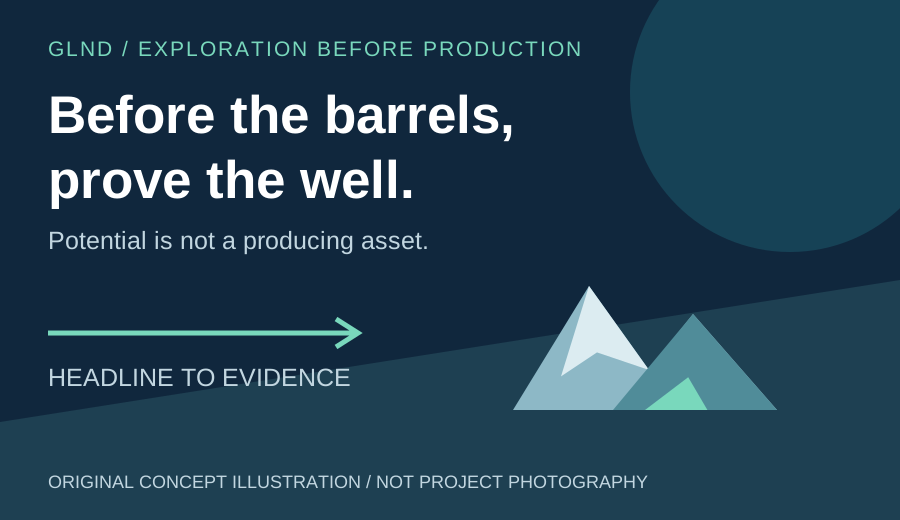
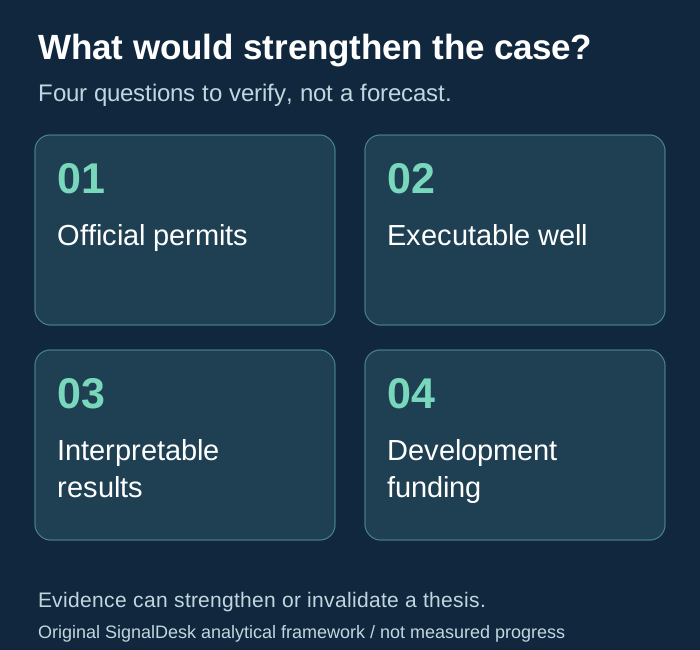
A higher oil price cannot turn an undrilled prospect into a producing field. GLND's story starts earlier in the chain: approvals, executable logistics, a funded well and results that can be interpreted commercially. Each step answers a different question.
Reading note: Presentation refreshed October 30, 2026. Original publication: 2026-10-14 (UTC). Figures, targets and company claims retain their original evidence dates; this is not a new verification or a live-price update.
Key takeaways
- Identify the right company. GLND's oil exploration is separate from GRML's mineral projects.
- A plan is not a spud. The dated winter-program revision does not prove that approvals or drilling followed.
- Ownership is conditional. An earn-in opportunity must be read with its funding and drilling obligations.
- Discovery is not development. Reservoir quality, infrastructure, financing and dilution still govern the path to shareholder value.
Research note prepared for October 14, 2026. Greenland Energy Company trades on Nasdaq as GLND and is pursuing onshore oil exploration in East Greenland's Jameson Land Basin. It should not be confused with Greenland Mines, the separate Nasdaq-listed company trading as GRML. GLND's investment question concerns exploration, permits, and execution, rather than a producing oilfield with demonstrated cash flow.
First distinguish the research date from the news date
This is an October 14 research assessment, not a claim that a new drilling result was released today. The directly reviewed shareholder letter is dated August 6, 2026. It describes progress toward remaining drilling approvals and revises the 2026-2027 winter program to one exploration well rather than two in the current field season. Those statements should be checked against any later regulatory or company announcement before publication or an investment decision.
The letter attributes the narrower program to operational, environmental, and safety priorities, not funding constraints. That is management's explanation. It does not establish that permits were subsequently granted, that drilling has begun, or that a discovery has been made.
Understand the partners and the earn-in
The company's project description says Greenland Energy will fund the costs of two exploration wells and can earn up to a 70% interest in the basin under its agreement with 80 Mile. That is a conditional earn-in arrangement, not confirmation that GLND already owns an unconditional 70% interest or that the first well alone earns the full amount.
In the August letter, 80 Mile is identified as the licensee leading permitting and stakeholder engagement. Greenland Energy supports technical planning, engineering, logistics, procurement, and project coordination. Keeping those responsibilities distinct helps investors identify which announcement actually demonstrates progress toward approvals.
The constructive case
Up to 70%
Potential basin interestThe company's description of the earn-in opportunity, subject to agreement terms and drilling obligations.
One first well
A defined near-term testThe revised winter program can provide information about the basin, but a planned well is not a producing asset.
Historical exploration work and specialist contractor relationships can support a more informed drilling campaign than starting without geological context. A successful first well could reduce some subsurface uncertainty and help determine the next program. The thesis strengthens with documented approvals, equipment readiness, actual drilling progress, and independently interpretable results.
Why headline potential is not shareholder value
Potential oil volumes are not proved reserves, recoverable production, or cash in the bank. Even a hydrocarbon encounter must be evaluated for reservoir quality, flow characteristics, development requirements, and commercial viability. Multiplying a basin estimate by the oil price is not a defensible equity valuation.
Arctic operations introduce weather windows, remote supply chains, equipment reliability, environmental obligations, and seasonal scheduling risks. A missed operational window can affect both cost and timing. A successful exploration result may still require years of appraisal, financing, infrastructure, and approvals before production.
Risks and next checkpoints
- Permitting: confirm the final approvals from the responsible authorities, not just constructive meetings.
- Exploration: a well can fail to find commercial hydrocarbons, regardless of seismic targets.
- Funding: review cash, committed drilling costs, contingency allowances, and the consequences of delays.
- Dilution: new equity, warrants, or other financing can change the value attributable to each share.
- Earn-in terms: verify when interests vest, what costs must be funded, and what happens after an unsuccessful well.
- Operational execution: track contractor mobilization, site readiness, spud confirmation, and completion reports.
- Development economics: distinguish a discovery from a funded, permitted production plan.
Bottom line
GLND is a high-risk frontier-exploration candidate. The first questions are whether the required approvals exist, whether the revised well program is executable, and whether the balance sheet can support it. Geological upside matters only after it is tested, and a discovery matters to shareholders only after ownership, costs, financing, and commercial economics are understood.
Sources and evidence date
Evidence reviewed October 14, 2026. The revised single-well winter plan and division of responsibilities come from Greenland Energy's August 6 shareholder letter distributed by PRNewswire and reproduced by Yahoo Finance: https://finance.yahoo.com/energy/articles/greenland-energy-company-issues-shareholder-110000776.html
SEC-filed letter: https://www.sec.gov/Archives/edgar/data/2093507/000182912626008417/greenlandenergy_ex99-1.htm
Company project description and subsequent updates: https://greenlandenergyco.com/ and https://greenlandenergyco.com/news/
The small/micro-cap label follows the portal's delayed October 14 snapshot. Extreme-volatility and speculative-risk labels are editorial cautions. No live price, new discovery, approved permit, or completed drilling is asserted here. Educational commentary only; not personalized investment advice.
Connect the research
Do not confuse the two Greenland businesses; the mineral-development counterpart is Greenland Mines (GRML): Resources Need Recovery, Funding, and Mine Economics. It retains its own research and reporting dates.
For the broader oil-price mechanism, rather than a claim that GLND is already producing, read Oil and the Middle East Crisis: Sectors Under Pressure and Stocks to Watch. It retains its own research and reporting dates.
What would change your view?
Which checkpoint would most reduce uncertainty for you: official permits, spud confirmation or independently interpretable well results? Add your reasoning and a dated source in the article discussion below, or continue in the $GLND Stock Room. Challenge the evidence and assumptions, not other readers.
Presentation-only refresh: original sources, dated figures, forecast caveats and disclosure statements are retained. The new illustrations explain the analytical questions; they are not current-price charts or forecasts.