
Engineering achievement is easier to admire than equity value is to calculate. The SPCX research question is how launch capability, satellite economics and investment needs translate into cash for the particular security being purchased, at the price actually paid.
Reading note: Presentation refreshed October 30, 2026. Original publication: 2026-10-14 (UTC). Figures, targets and company claims retain their original evidence dates; this is not a new verification or a live-price update.
Key takeaways
- Verify the security. The original note identifies a specific listed share class, not generic exposure to a familiar brand.
- Keep IPO facts historical. Offering prices, issuance and gross proceeds are not current quotations, total capitalization or remaining cash.
- Separate operating engines. Launch services, satellite connectivity and development programs have different economics.
- Price still matters. Strong execution can coexist with poor investment returns when expectations or dilution are too demanding.
Research note prepared for October 14, 2026. Space Exploration Technologies Corp., commonly known as SpaceX, is now publicly traded under SPCX. The company's official IPO closing release states that Class A shares began trading on the Nasdaq Global Select Market and Nasdaq Texas on June 12, 2026. An article that still treats SpaceX as a private company with no listed ticker would be outdated for this evidence date.
Start with the security, not the familiar name
The listed Class A shares are a particular security in Space Exploration Technologies Corp. Investors should read the prospectus and subsequent reports to understand exactly which activities, subsidiaries, voting rights, related-party arrangements, and liabilities they are buying. A recognizable brand does not remove the need to check corporate structure and financial statements.
This note does not claim that a new SpaceX announcement occurred on October 14. It uses the verified IPO milestone as a starting point for a current research checklist. The June offering price is historical and is not a live quotation or a recommended entry price.
The confirmed financing milestone
June 12, 2026
Start of listed tradingConfirmed by the company's official IPO closing announcement under the symbol SPCX.
About $85.7B
Gross IPO proceedsThe company reported this amount after the offering and full exercise of the underwriters' option closed on June 15. Gross proceeds are not net proceeds or today's remaining cash.
638,888,888 shares
Class A shares issued in the offeringThis is the aggregate IPO issuance, not the company's complete current fully diluted share count.
The pricing announcement specified a $135 offering price per share. That price describes the June transaction only. Neither that figure nor the total funds raised establishes whether today's shares are undervalued.
How to evaluate the operating thesis
A disciplined SpaceX assessment separates launch and mission services, satellite-connectivity economics, and development-intensive programs. Launch cadence and successful missions can demonstrate capability, but revenue recognition, pricing, operating margins, and cash requirements determine the financial outcome.
For recurring satellite services, subscriber counts alone are insufficient. Review revenue per customer, service costs, customer equipment economics, churn, capacity, competition, regulatory permissions, and the cost of maintaining and replacing the network. For new vehicle and infrastructure programs, distinguish engineering milestones from funded, repeatable commercial operations.
Why the valuation still matters
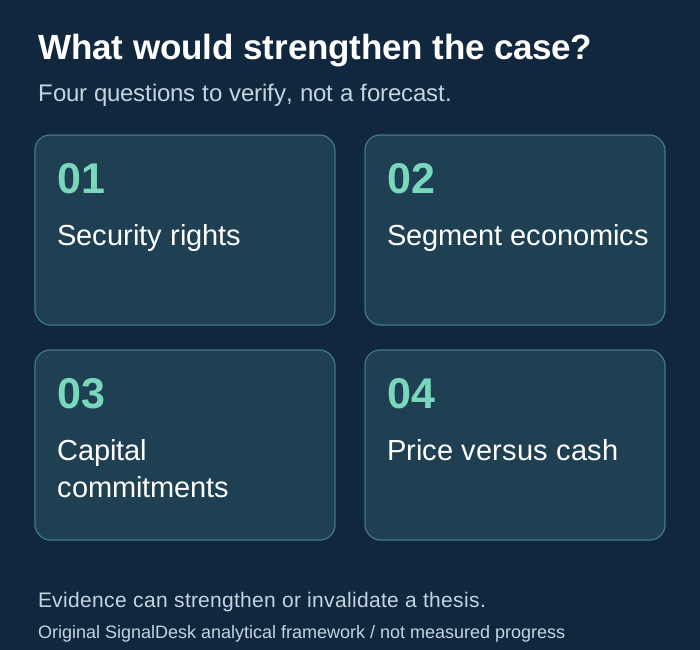
A company can execute well while its shares deliver poor returns if the purchase price already assumes unusually favorable growth and margins. Conversely, a lower price does not eliminate operational, financing, governance, or regulatory risk. Use the latest reported revenue, segment information, free cash flow, net cash or debt, and fully diluted share count before applying any valuation multiple.
Gross IPO proceeds can support investment, but they should not be treated as permanent surplus cash. Check net proceeds, their stated uses, actual capital spending, acquisitions, commitments, and cash-flow reporting. Avoid multiplying the IPO share issuance by a market price and calling the result the company's total equity value; the complete capitalization matters.
Risks and research checkpoints
- Launch and development execution: test failures, mission delays, or redesigns can affect spending and customer schedules.
- Capital intensity: spacecraft, satellite replacement, launch facilities, and network infrastructure consume cash.
- Regulation: launch permissions, spectrum rights, orbital safety, and international operating approvals can constrain growth.
- Customer and contract exposure: examine government and commercial concentration, payment terms, and delivery obligations.
- Governance: read voting-control provisions, related-party arrangements, and the rights of public Class A holders.
- Valuation and liquidity: check current trading conditions, lockup disclosures, potential share supply, and fully diluted capitalization.
- Competition: superior engineering does not automatically imply pricing power across every business line.
Bottom line
SPCX is the verified listed code for SpaceX, not a placeholder for a future IPO. The next research step is to connect operating evidence to reported financial outcomes and then assess the price paid for those outcomes. A strong space franchise, an enormous fundraising, and an attractive stock investment are three different propositions; none should be assumed to prove the others.
Sources and evidence date
Evidence reviewed October 14, 2026. Official IPO pricing release: https://ir.spacex.com/updates/releases-details/2026/Space-Exploration-Technologies-Corp--Announces-Pricing-of-Initial-Public-Offering/default.aspx
Official closing release confirming issuance, gross proceeds, trading date, and SPCX ticker: https://ir.spacex.com/updates/releases-details/2026/Space-Exploration-Technologies-Corp--Announces-Closing-of-Initial-Public-Offering-Including-Full-Exercise-of-Underwriters-Option-to-Purchase-Additional-Shares-2026-RgoR-Y1Vwh/default.aspx
Subsequent investor disclosures and company information: https://ir.spacex.com/ and https://www.spacex.com/
The large-cap label follows the portal's delayed October 14 snapshot. High-volatility and high-risk labels are editorial cautions, not measured forecasts or a statement that failure is inevitable. No same-day price, earnings result, or target return is invented here. Educational commentary only; not personalized investment advice.
Connect the research
For a different engineering-intensive business where technical progress is not commercial proof, compare XNDU Stock: DARPA Support, GlobalFoundries Scale-Up and the Valuation Test. It retains its own research and reporting dates.
For a separate illustration of why gross financing and complete capitalization must not be confused, read SKYD Stock: Malone's Netflix Claim, Warner Deal Economics and Analyst Forecasts. It retains its own research and reporting dates.
What would change your view?
What would you examine first for SPCX: segment cash economics, full capitalization or the spending required to maintain the network? Add your reasoning and a dated source in the article discussion below, or continue in the $SPCX Stock Room. Challenge the evidence and assumptions, not other readers.
Presentation-only refresh: original sources, dated figures, forecast caveats and disclosure statements are retained. The new illustrations explain the analytical questions; they are not current-price charts or forecasts.