
Outside support and a manufacturing partner can make a technology roadmap more concrete. They do not remove the distance between a promising architecture and a useful, economically supportable product. That distance is where the XNDU investment questions belong.
Reading note: Presentation refreshed October 30, 2026. Original publication: 2026-10-19 (UTC). Figures, targets and company claims retain their original evidence dates; this is not a new verification or a live-price update.
Key takeaways
- Provisional means conditional. Announced DARPA support is not proof that all funding has arrived or that the final program objective is met.
- A partner is not a customer order. Manufacturing collaboration does not establish profitable high-volume deliveries.
- Engineering definitions matter. Component cooling and full-system requirements cannot be inferred from a broad architecture label.
- Keep valuation current and consistent. Historical currencies, book-value ratios and dated cash balances are not interchangeable.
Xanadu Quantum Technologies (NASDAQ/TSX: XNDU) has two fresh reasons to attract attention: provisional approval for up to US$10 million of additional DARPA project funding and a multi-year manufacturing partnership with GlobalFoundries. Together, the developments address two different challenges: independent scrutiny of the technology roadmap and a route toward producing critical components at industrial scale. Neither announcement, by itself, establishes a profitable quantum-computing business or an attractive entry price for the stock.
This research note is dated 19 October 2026. It combines the two supplied Yahoo Finance articles with Xanadu's syndicated company announcements, DARPA's own program description and additional specialist reporting. Company targets are identified as targets, historical valuation figures are not treated as current quotes, and all financial figures below are US dollars unless explicitly marked CA$.
What investors are actually buying
Xanadu is a Canadian quantum-computing developer founded in 2016. Its hardware approach uses photons, or particles of light, to carry quantum information. It also develops PennyLane, an open-source quantum-computing software platform. The investment thesis is not simply that quantum computing becomes important: Xanadu must turn its architecture, software and partnerships into useful systems with economics that customers will support.
The company emphasizes room-temperature compute operations and modular networking. That does not mean every part of a complete machine operates without cooling. The GlobalFoundries collaboration includes superconducting nanowire single-photon detectors; investors should distinguish the optical computing approach from the engineering requirements of its detector subsystems. Nor should a demonstration of networkability be confused with proof of commercially useful, fault-tolerant operation.
DARPA: a meaningful research checkpoint, not a commercial victory
In its 19 October announcement, Xanadu said it had received provisional approval for up to US$10 million under DARPA's Quantum Benchmarking Initiative, through a one-year contract extension building on its Stage B work. The company expects to provide progress reports while directing most of the funding toward critical research-and-development components over the following 12 months. Its risk disclosures explicitly warn that it might not receive the full amount on the expected timetable, or at all.
DARPA describes QBI as an effort to determine whether an industrially useful quantum computer can be built by 2033, with computational value exceeding its cost. Stage B is about developing and assessing an R&D plan, technical risks and risk-reduction prototypes. DARPA's participant list, current as of 8 October, places Xanadu in Stage B. The 19 October extension should not be presented as a Stage C award or a declaration that Xanadu has already met the program's ultimate objective.
The distinction matters because QBI is not a winner-takes-all competition. DARPA evaluates multiple architectures and says that multiple, one or even no participants may demonstrate a viable path. Continued participation is useful external engagement and potential non-equity funding, but not a government guarantee of future commercial success.
The supplied Investing.com report described an approximately 3% early-trading rise on the announcement. That is a time-specific news reaction, not a verified closing return or the current price. A positive headline reaction cannot establish that a stock is undervalued.
GlobalFoundries: a route to manufacturing, not an order book
The 6 October partnership announcement describes industrializing ultra-low-loss silicon nitride photonics and superconducting nanowire single-photon detectors using GlobalFoundries' 300 mm production line in Malta, New York. Low optical loss helps preserve photons as they move through a system, while efficient detectors are essential for reading outputs. Improving both could reduce the engineering overhead required for Xanadu's intended architecture.
A semiconductor manufacturing partner can help bridge the gap between laboratory components and repeatable production processes. The relevant future evidence includes device yield, loss and detector performance, packaging, reliability, manufacturing cost and integration into fault-tolerant demonstrators. The agreement is therefore strategically important, but the announcement does not establish completed high-volume deliveries, a disclosed stream of customer revenue or profitable utility-scale computers. GlobalFoundries' role as a manufacturing partner should not be mistaken for a purchase commitment for Xanadu's finished systems.
Bull case by the numbers
Up to US$10M
Provisional DARPA supportA one-year extension announced on 19 October supports the R&D roadmap, subject to funding conditions and continued evaluation. It is not cash already received in full.
300 mm
Industrial manufacturing pathwayThe GlobalFoundries partnership targets critical photonic components on its Malta production line. Wafer size describes the manufacturing platform, not delivered quantum-computing capacity.
US$312.8M
Reported quarter-end cashXanadu's 5 August Q2 release reported this cash balance at 30 June 2026. It supports investment capacity but is not a verified October cash balance.
Bear case by the numbers
US$1.5M vs US$42.1M
Q2 revenue versus net lossThe company reported modest revenue and a much larger GAAP loss for the quarter ended 30 June. Net loss includes accounting effects and is not identical to cash burn.
US$21.3M
Q2 adjusted EBITDA lossThis non-GAAP loss shows the early-stage operating burden, but excludes items and must not be treated as operating cash flow or used alone to calculate runway.
5.5M shares
Q2 equity-facility issuanceThe company raised US$67.2M through its Yorkville facility during Q2. The cash strengthens resources while additional shares dilute existing ownership.
The same Q2 release reported US$19.7 million of R&D expense and approximately US$6.4 million of capital expenditures. The Yorkville standby equity purchase agreement was established in May for up to US$300 million over three years, with issuance optional rather than compulsory. That headline facility size is not an additional cash balance, and its original capacity is not the amount necessarily available today. Later issuance and subsequent disclosures must be checked.
For scale, the maximum US$10 million of newly announced DARPA funding is about 3.2% of the reported June cash balance. That comparison uses different dates and is not a liquidity forecast. It illustrates why the program's technical evaluation may be as important to the thesis as the funding amount itself. A credible runway estimate requires the latest operating cash flow, capital commitments, spending plans and financing activity, not cash divided by accounting losses.
Valuation: do not carry an old Canadian snapshot into today's trade
The supplied Simply Wall St article, identified as 7 October 2026 in its feedback metadata, cited a TSX closing price of CA$7.21, a price-to-book ratio of 4.9x and a Canadian software peer average of 3.4x. It also cited CA$7.21 million of revenue and a CA$105.98 million net loss, without providing the full reporting-period and accounting context in the excerpt. These are attributed historical figures from that article, not independently recalculated current ratios or figures interchangeable with Xanadu's US-dollar Q2 release.
The caution about paying for distant commercialization is sensible, but price-to-book is not a complete valuation model for a research-intensive quantum hardware company. Book assets may not capture internally developed intellectual property, software-sector peers may not share its economics, and recapitalization or financing can complicate comparisons. A ratio above peers does not prove overvaluation, just as a large share-price decline does not prove a bargain. The article's forecast of 66.8% annual revenue growth is a forecast, not contracted sales or guidance verified in this note.
Before assigning an investment value, reconcile the current share price, exchange and currency, all relevant share classes, equity-linked instruments, cash, debt and the applicable financial-statement period. Do not calculate market capitalization from one share class while ignoring others, or combine a Canadian quote with an unconverted US-dollar balance sheet. This note does not assert a current P/B ratio, a current market-cap estimate or a price target.
What would strengthen or weaken the thesis?
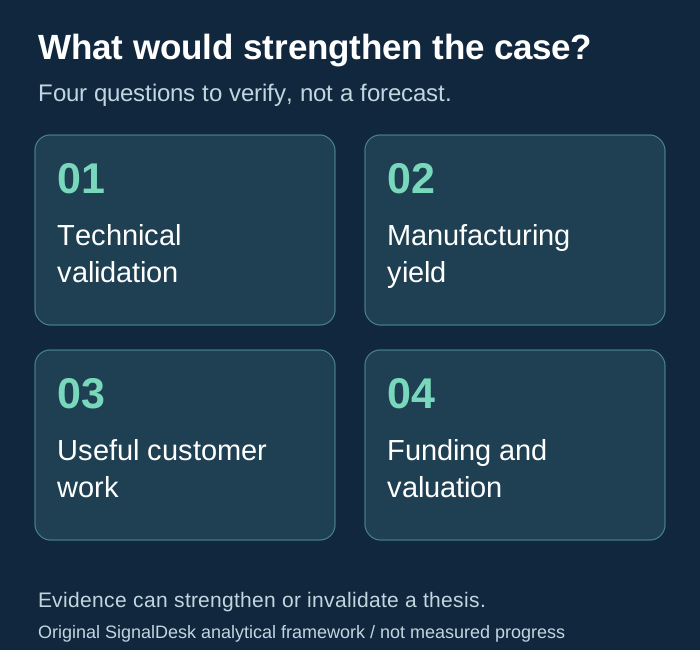
- Technical progress: independently assessed reductions in optical loss and better detector efficiency, alongside credible integration into larger systems, would strengthen the case. Delays or performance shortfalls would weaken it.
- Manufacturing execution: repeatable fabrication, acceptable yields and disclosed cost improvements would be more informative than partnership headlines alone.
- DARPA progression: verified milestones and any formal next-stage award would matter. Additional stages should not be assumed before they are announced.
- Commercial conversion: paid deployments, recurring software or service revenue and disclosed customer economics would help distinguish commercial adoption from research collaborations.
- Financial discipline: track operating cash flow, capital expenditure, remaining cash, contractual commitments and fully diluted ownership. A higher cash balance funded by issuance is not the same as self-financing growth.
- Valuation discipline: compare a reconciled enterprise value with realistic development and adoption scenarios. Even successful technology can produce poor shareholder returns if the entry valuation is excessive or dilution is substantial.
Bottom line
DARPA support and GlobalFoundries manufacturing access make Xanadu's development story more tangible: one provides continued evaluation and potential funding, while the other targets a production bottleneck. The investable question remains whether these steps lead to useful systems, sustainable customer demand and acceptable returns per share. Q2's small revenue base, substantial losses and equity issuance show why the distinction matters.
XNDU belongs on a speculative, milestone-driven research watchlist rather than being treated as a proven commercial quantum winner. The strongest next evidence would be independently assessed technical progress, reproducible manufacturing results, measurable customer revenue and transparent cash and share-count disclosures. This is educational commentary, not personalized investment advice or a recommendation to buy or sell.
Sources and verification notes
- Investing.com via Yahoo Finance, supplied article, DARPA announcement and early-trading reaction: https://finance.yahoo.com/markets/stocks/articles/xanadu-quantum-stock-rises-darpa-140427940.html
- Simply Wall St via Yahoo Finance, supplied article, historical Canadian valuation snapshot; its assumptions and figures are attributed rather than adopted as current: https://finance.yahoo.com/markets/stocks/articles/xanadu-quantum-technologies-tsx-xndu-201243055.html
- Xanadu company release via GlobeNewswire/Yahoo Finance, 19 October 2026, provisional funding terms and risk disclosures: https://finance.yahoo.com/technology/ai/articles/xanadu-secures-usd-10-million-110000061.html
- DARPA, Quantum Benchmarking Initiative, program objectives, stages and participant list current as of 8 October 2026: https://www.darpa.mil/research/programs/quantum-benchmarking-initiative
- Xanadu/GlobalFoundries announcement reproduced by The Quantum Insider, 6 October 2026, component and manufacturing details: https://thequantuminsider.com/2026/10/06/xanadu-globalfoundries-photonic-quantum-manufacturing/
- Xanadu Q2 2026 company release via GlobeNewswire/Finviz, 5 August 2026, financial results, US-dollar presentation and equity-facility terms: https://finviz.com/news/377900/xanadu-announces-second-quarter-2026-results
Sources accessed on 19 October 2026. Syndicated copies were used where company investor-relations pages were inaccessible. This article independently analyzes the announcements; it does not reproduce either supplied article. Subsequent filings, financing and market prices may change the assessment.
Connect the research
For a different computing investment theme, not a set of quantum peers, compare the business models in Data Center Stocks: A Small-, Mid- and Large-Cap Guide to Power, Profits and Funding Risk. It retains its own research and reporting dates.
What would change your view?
What would move XNDU beyond a roadmap in your analysis: independent technical evidence, manufacturing performance or paid useful workloads? Add your reasoning and a dated source in the article discussion below, or continue in the $XNDU Stock Room. Challenge the evidence and assumptions, not other readers.
Presentation-only refresh: original sources, dated figures, forecast caveats and disclosure statements are retained. The new illustrations explain the analytical questions; they are not current-price charts or forecasts.