
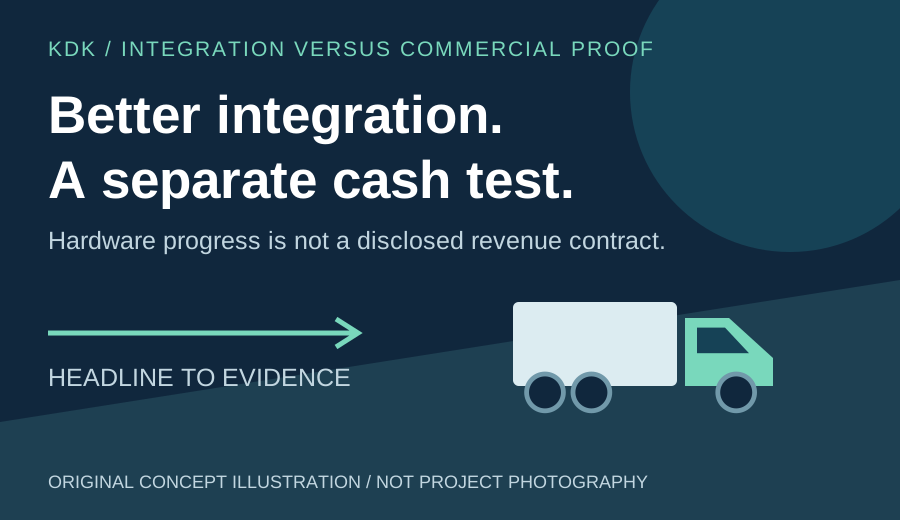
A better-integrated truck can be meaningful engineering progress without answering the valuation question. This earlier KDK note separates the Stoneridge collaboration from the evidence still needed on deployment, paid operations and the cost of scaling.
Reading note: Presentation refreshed October 30, 2026. Original publication: 2026-10-28 (UTC). Figures, targets and company claims retain their original evidence dates; this is not a new verification or a live-price update.
Key takeaways
- Integration is not a contract value. The collaboration release does not disclose the financial economics described as missing below.
- Separate operating domains. Industrial uptime and supervised highway work do not establish unsupervised highway economics.
- Read ratings as dated opinions. Aggregated analyst targets are not company guidance or expected returns.
- Launch evidence matters. A readiness measure, a reporting date and an actual operating launch are different things.
Research checked 28 October 2026. This is a dated review of company disclosures and third-party analyst estimates, not live quote commentary. KDK's chart is dynamic: https://www.tradingview.com/symbols/NASDAQ-KDK/.
October 28: Stoneridge MirrorEye collaboration
Stoneridge and Kodiak announced that Stoneridge's MirrorEye camera-monitor system is now incorporated in newly deployed trucks equipped with the Kodiak Driver. MirrorEye replaces conventional side mirrors with exterior cameras and in-cab displays. Its Federal Motor Carrier Safety Administration exemption was renewed in 2024 for five years, allowing equipped trucks to operate without conventional rear-vision mirrors. Kodiak says that flexibility could support future SensorPods that are smaller, lighter, easier to replace and more aerodynamic. The companies also plan to explore integrating additional Stoneridge technologies and improving vehicle-data processing.
The release does not disclose a contract value, minimum order, deployment count, revenue contribution, or quantified fuel-efficiency gain. Treat the potential design benefits and further integration as forward-looking, not realized financial results. Primary release: https://www.prnewswire.com/news-releases/stoneridge-and-kodiak-ai-announce-collaboration-to-advance-autonomous-commercial-vehicles-302922481.html. Reuters/TradingView version: https://www.tradingview.com/news/reuters.com,2026:newsml_TUA7KVWW6:0-stoneridge-and-kodiak-ai-announce-collaboration-to-advance-autonomous-commercial-vehicles/.
Operating evidence and the launch test
On October 8, Kodiak and Charger USA announced freight operations on a 435-mile Dallas-Laredo route. Kodiak said the first delivery took place September 8 and that trucks were operating with a safety driver; the companies intend to move to driverless operations only after Kodiak completes its safety case. This is not yet a driverless public-highway service. Company release: https://kodiak.ai/news/kodiak-charger-usa-autonomous-trucking-dallas-laredo.
On October 20, Kodiak reported one Permian Basin truck ran 64 consecutive days without shutting down or restarting between June 30 and September 1; five other trucks exceeded 45 consecutive days. That is a useful uptime datapoint for one vehicle and a handful of others, not proof of fleet-wide uptime or highway readiness. Company release: https://investors.kodiak.ai/news-releases/news-release-details/kodiak-driver-sets-new-uptime-record-running-64-consecutive-days.
Kodiak's October 6 release put its company-defined long-haul Autonomy Readiness Measure at 96% at the end of September and reiterated a target to launch driverless long-haul service by year-end 2026. The measure is the percentage of claims and evidence in the company's safety case deemed materially complete; it is not an independent safety probability, regulatory approval, or guarantee that launch will occur on schedule. Company release: https://kodiak.ai/news/autonomy-readiness-96-driverless-long-haul-launch.
For financial context, Kodiak's Q2 2026 release reported $3.5 million revenue and $151.1 million in cash, cash equivalents and marketable securities at June 30. The company reported negative $38 million of free cash flow for the quarter and guided to negative $155 million to negative $162 million for full-year 2026. These are Q2-period figures and company guidance, not current cash or a runway estimate. The company also reported 35 customer-owned driverless trucks and more than 40,000 paid driverless hours at quarter-end. Q2 release: https://investors.kodiak.ai/news-releases/news-release-details/kodiak-ai-reports-second-quarter-2026-results-and-advances. SEC filings: https://investors.kodiak.ai/financial-information/sec-filings.
Kodiak scheduled its Q3 2026 results for after market close on November 5, with a call at 5:00 p.m. ET. That is a reporting date, not a result. The release and call are the next scheduled check on revenue, cash use and execution: https://investors.kodiak.ai/news-releases/news-release-details/kodiak-report-third-quarter-2026-financial-results-november-5.
Analyst ratings: a dated aggregator snapshot
As accessed October 28, MarketBeat's 12-month aggregation showed 11 analyst ratings: one Strong Buy, seven Buy, two Hold and one Sell. Its consensus label was Moderate Buy, with a mean 12-month target of $9.69 and a reported range of $4.50 to $13.00. These are analyst opinions, not company guidance or expected returns; MarketBeat notes that its methodology and consensus can differ from other providers. No target-price upside is calculated here because the stock quote is time-sensitive and analyst targets may be stale. Snapshot and methodology: https://www.marketbeat.com/stocks/NASDAQ/KDK/forecast/.
MarketBeat reported on October 26 that Chardan Capital had lowered its target to $4.50 while retaining a Buy rating; the research note was issued October 22. This illustrates the spread of views rather than validating any target: https://www.marketbeat.com/instant-alerts/analyst-chardan-capital-issues-pessimistic-forecast-for-kodiak-ai-nasdaq-kdk-stock-price-2026-10-22/.
What to watch
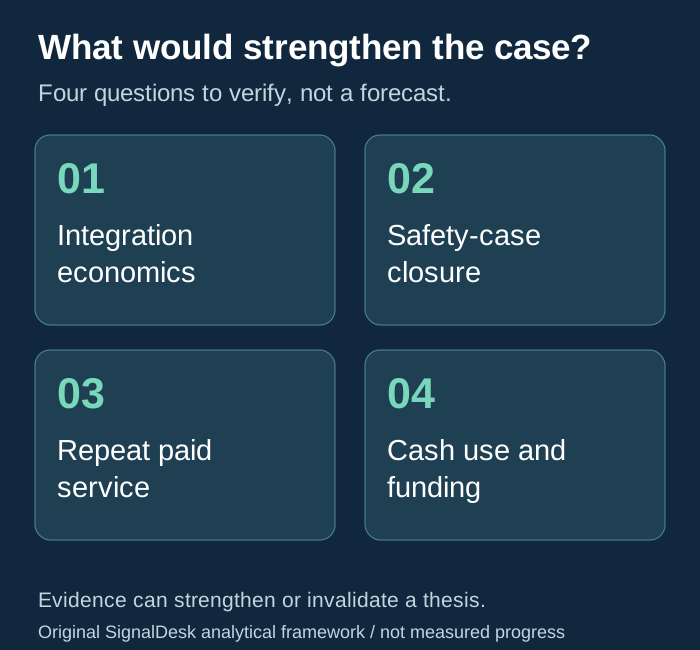
- Whether the Stoneridge integration expands into disclosed deployments, paid volume or measurable economics.
- Completion of the long-haul safety case and actual driverless operations on public highways, rather than a readiness percentage or target date.
- Q3 results on November 5, especially revenue conversion, cash consumption and any change to company guidance.
- Safety, regulatory, customer adoption, execution and financing risks as the business scales.
Bottom line: the October 28 announcement is a specific hardware-integration step, while the other releases add operating evidence. They do not yet establish the economics of the collaboration or a scaled driverless long-haul business. Analyst targets are unusually dispersed, and the Q2 cash balance must be read alongside cash use. No causal claim is made between the news and any share-price move. Educational commentary only; not investment advice.
Connect the research
For the later October 30 readiness update and the distinction between industrial and highway evidence, read KDK Stock: 99% Readiness Is Not a Finished Investment Case. It retains its own research and reporting dates.
What would change your view?
Which would add more substance to the KDK partnership: disclosed deployments, measurable customer economics or repeat driverless highway service? Add your reasoning and a dated source in the article discussion below, or continue in the $KDK Stock Room. Challenge the evidence and assumptions, not other readers.
Presentation-only refresh: original sources, dated figures, forecast caveats and disclosure statements are retained. The new illustrations explain the analytical questions; they are not current-price charts or forecasts.