
Cathie Wood's latest reported trading offers a useful research map, not a ready-made portfolio. The common thread runs from AI infrastructure into machines operating in the physical world: chip-testing equipment, defense systems, autonomous trucks and proposed air-taxi networks. But these businesses sit at very different stages of commercialization.
Research date: November 2, 2026 (UTC). This is an original analysis of the linked Seeking Alpha recap carried by TradingView, supplemented by company earnings releases and Kodiak's October 30 company announcement. Reported trade values are approximate secondary-source estimates, not verified execution prices. No live stock quotes or price targets are supplied.
Key takeaways
- Trades identify questions, not answers. The recap reports substantial TER and AVAV purchases and smaller KDK buying; it does not establish ARK's execution prices, current position weights or internal rationale.
- TER has an earnings base to examine. Its October 27 release reports $1.306 billion of quarterly revenue and $2.17 of GAAP diluted EPS, alongside strong annual growth but a sequential revenue decline.
- AVAV's backlog is not booked profit. Funded backlog rose 37% year over year, while the same quarter still recorded a GAAP operating loss.
- KDK's 99% is a company-defined readiness measure. It is neither a 99% safety probability nor proof that the planned driverless highway service has launched.
- Selling does not establish a broken thesis. AMD, TSM and LLY reductions do not reveal tax lots, realized gains or whether the underlying businesses have deteriorated.
What the linked recap actually reports
The Seeking Alpha article distributed by TradingView reports purchases of approximately 74,690 Teradyne shares valued at $23.3 million and 150,900 AeroVironment shares valued at $19.2 million. It also reports roughly $8.2 million of Kratos Defense buying and $1.7 million of Kodiak AI buying. In adjacent themes, the reported additions include $11.2 million of Joby Aviation, $11 million of Archer Aviation and $13.6 million of Circle Internet Group.
On the other side, the recap describes approximately $32.6 million of AMD sales, $24.6 million of TSMC sales and $25 million of Eli Lilly sales. Those amounts are reported transaction estimates, not comparable position weights. A small purchase can be significant for one fund but immaterial across the manager's combined assets.
This review did not independently reconcile the weekly totals against every fund's daily trade files, starting holdings, subscriptions or redemptions. It also does not verify the exact trading-week boundaries from a timestamped original notification set. The proper description is therefore reported buying and selling in the linked recap, not independently audited net flows or a claim that the trades occurred today.
TER: strong annual growth, a more demanding sequential test
Teradyne's October 27 company release provides a firmer operating anchor than the trading headline. Third-quarter 2026 revenue was $1.306 billion versus $769 million a year earlier, approximately 70% growth. Semiconductor Test contributed $1.072 billion, Product Test $138 million and Robotics $96 million. The company reported GAAP diluted EPS of $2.17 and non-GAAP diluted EPS of $2.29; the adjusted measure excludes specified charges and should not replace the GAAP figure.
There is an important counterweight: second-quarter revenue was $1.329 billion. Using the rounded company figures, third-quarter revenue declined approximately 1.7% sequentially. Fourth-quarter revenue guidance of $1.25 billion to $1.35 billion has a $1.30 billion midpoint, roughly flat against the third quarter. Guidance is management's forecast, not an achieved result.
Our interpretation is that TER offers an established way to study AI-related capital spending without owning only chip designers. It does not follow that the shares are inexpensive. The next work is to test customer concentration, testing intensity, product mix, margins and the valuation investors are paying for the growth. Annual growth and sequential momentum answer different questions.
AVAV: funded demand still has to become deliveries and cash
AeroVironment's September 9 company release, reproduced by Yahoo Finance, covers its fiscal 2027 first quarter ended August 1, 2026. That fiscal label is not calendar-year 2027 performance. Revenue was $480.5 million, up 6% year over year. Funded backlog reached approximately $1.5 billion, up 37%, and book-to-bill was 1.4.
Funded backlog is useful evidence of contracted demand, but it is not revenue already recognized, cash already collected or profit already earned. The release also reports a $10.9 million operating loss and $43.4 million of intangible amortization and related non-cash purchase-accounting expenses affecting the quarter. These accounting effects matter when comparing periods; they do not justify assuming that every backlog dollar will turn into an attractive shareholder return.
For AVAV and the separately reported KTOS purchases, the practical research agenda is contract funding, manufacturing capacity, delivery schedules, margins and cash conversion. The defense theme can be attractive while individual programs still face delays, cost pressure or shifting procurement priorities. This article does not independently review Kratos's financial results or assign it AeroVironment's metrics.
KDK: the October 30 update is newer than the 96% milestone
Kodiak's October 30 company announcement, distributed by GlobeNewswire and reproduced by FinancialContent, states that its Autonomy Readiness Measure reached 99%. The release describes this as the percentage of claims and evidence in its long-haul driverless safety case that are materially complete. September's reported figure was 96%; using that older figure as the latest milestone would miss the October update.
The company says that, after completing the safety case, it plans to launch driverless commercial highway operations on Interstate 45 between Dallas and Houston by the end of 2026, with an initial 219-mile route and IKEA as a shipper launch partner. These are company plans. The announcement does not establish that the highway launch has already happened, and the final percentage point need not require the same effort as earlier increments.
The same release says that 35 trucks using Kodiak technology were operating without humans in the cab in the Permian Basin as of the end of the second quarter. It identifies Atlas Energy Solutions as the owner and operator of those trucks. That industrial deployment is not interchangeable with completion of the separate highway safety case or company-owned fleet economics.
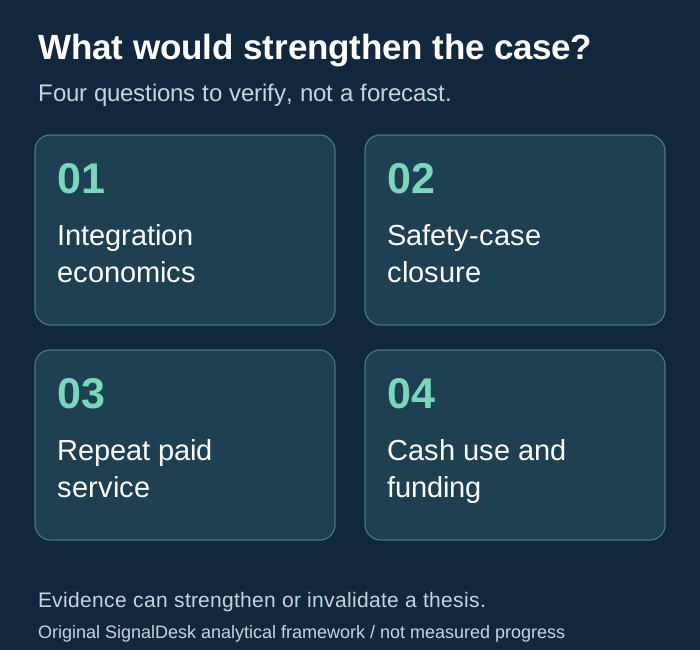
For shareholders, the next useful evidence is a completed safety case within a defined operating scope, an actual unsupervised highway launch, repeat paid operations, customer economics and financial statements showing the cash required to scale. A fund's reported $1.7 million purchase does not supply that evidence. Our related article, KDK: 99% readiness is not a finished investment case, develops the launch, economics and funding questions in more detail.
JOBY, ACHR and CRCL: adjacent trades, different business tests
The reported Joby and Archer additions fit a broad autonomy narrative, but autonomous trucking and electric air taxis are not the same commercial proposition. For JOBY and ACHR, investors should separately examine certification, production readiness, service approvals, infrastructure, cash use and financing. A reported purchase establishes none of those milestones. This article has not independently checked their latest certification status and does not imply that either has obtained a particular approval.
Circle belongs to a different operating framework: stablecoin distribution, reserve economics, interest-rate sensitivity and regulation. CRCL buying should not be treated as evidence that ARK's entire weekly activity was a single defense or robotics bet. The recap also covers other healthcare, brokerage and crypto exposures; this note deliberately focuses on ten named stocks rather than presenting an exhaustive holdings report.
AMD, TSM and LLY: a trim is not a sell thesis
A manager can reduce a holding after appreciation, manage concentration, fund other purchases or respond to portfolio flows without concluding that the issuer's business has weakened. The linked headline uses profit-taking language, but realized gains require execution and cost-basis information not established here.
The recap's AMD and TSMC sales therefore cannot, by themselves, establish that AI demand is fading. TER's independently checked test-equipment results address a different point in the semiconductor chain. Likewise, the reported Lilly reduction is not evidence that demand for its medicines has reversed. This note does not independently verify the recap's AMD and TSMC year-to-date returns, AMD transaction claims or Lilly earnings figures, and does not use them to calculate valuation or projected returns.
A watchlist built around evidence, not imitation
- TER: check the next revenue mix, margins and outlook against the near-flat fourth-quarter revenue midpoint, not only the 70% annual growth headline.
- AVAV and KTOS: distinguish funded awards, manufacturing throughput, recognized revenue and cash receipts. Review each company separately.
- KDK: look for highway launch evidence and repeat paid service, then connect utilization and customer economics to cash requirements.
- JOBY and ACHR: verify approvals and manufacturing progress against liquidity and financing needs before treating a launch timetable as accomplished.
- CRCL: examine the relationship between stablecoin activity, reserve income, distribution costs and regulation.
- AMD, TSM and LLY: evaluate operating results and valuation on their own merits; a manager's reduction is not a substitute for company research.
The central conclusion is not that investors should copy ARK. It is that a reported rotation creates a useful comparison across profitable infrastructure suppliers, defense delivery businesses and earlier-stage commercial platforms. The evidence needed to justify ownership differs substantially across those categories.
Sources and evidence limits
- Seeking Alpha recap carried by TradingView: source of all reported weekly trade quantities and dollar estimates in this article. Weekly totals and execution details were not independently reconciled.
- Teradyne: third-quarter 2026 results, October 27: primary company release for TER's revenue, segment mix, GAAP and non-GAAP EPS, prior-quarter comparison and fourth-quarter guidance.
- AeroVironment: fiscal 2027 first-quarter results, September 9: company release reproduced by Yahoo Finance, covering the quarter ended August 1, 2026. Source of the revenue, funded backlog, book-to-bill and operating-loss figures used here.
- Kodiak: readiness reaches 99%, October 30: company announcement distributed by GlobeNewswire and reproduced by FinancialContent. Source of the readiness definition, launch plans and industrial-fleet disclosure. Kodiak's investor-relations pages returned access errors during this review; the reproduced company release was used instead.
- ARK trade notifications: official navigation point for further trade verification, not evidence that this review completed a fund-by-fund reconciliation.
Disclosure
Educational research, not personalized investment advice or a recommendation to buy, sell or copy any fund. Company statements and forecasts are attributed, not independently certified. Share prices, valuation multiples, execution conditions and complete financial statements have not been independently reviewed here. Smaller and pre-commercial businesses can face substantial volatility, dilution and permanent capital loss. Author positions and commercial relationships have not been supplied for verification; readers should not infer an absence of interests.