
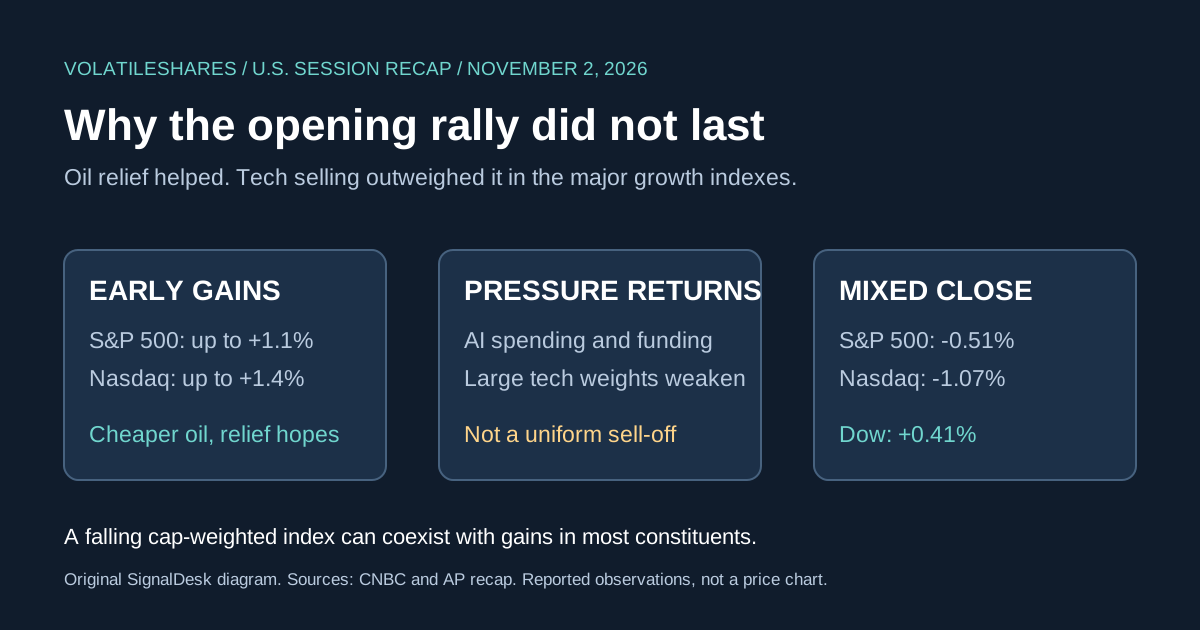
Yesterday's U.S. session began with a reason for optimism: oil prices were falling sharply as investors assessed the possibility of renewed U.S.-Iran peace talks. But cheaper oil did not resolve the market's other big concern: how much investors should pay for technology companies facing enormous AI investment and funding requirements.
The result on Monday, November 2, 2026 was a genuine reversal for the S&P 500 and Nasdaq Composite, not merely a smaller positive finish. Both surrendered gains of more than 1% and closed lower. The Dow Jones Industrial Average held onto a gain. The explanation is therefore more specific than the entire market suddenly turning bearish: weakness in influential technology shares outweighed improving conditions elsewhere.
Research date: November 3, 2026. Session covered: November 2 U.S. regular trading. Closing figures and intraday observations below come from dated reporting, not a live quote feed. Reported catalysts and our interpretation are separated; the evidence does not establish a single trigger or explain every trade.
Key takeaways
- The opening optimism had a basis. Falling oil prices on diplomatic hopes offered relief from an important inflation and business-cost pressure.
- The reversal was concentrated, not universal. The S&P 500 and Nasdaq finished lower, while the Dow rose and the majority of stocks advanced, according to AP's recap.
- AI spending and financing concerns remained unresolved. Selling in technology and semiconductor shares overpowered the relief rally in the cap-weighted indexes.
- Not every headline arrived in time to explain the move. Apple and Palantir earnings released after the bell cannot retrospectively explain an earlier regular-session decline.
- Election risk was a backdrop, not a proven sell signal. Tuesday's midterms added uncertainty; Monday's tape does not establish a single election-driven cause.
What actually happened: the scorecard
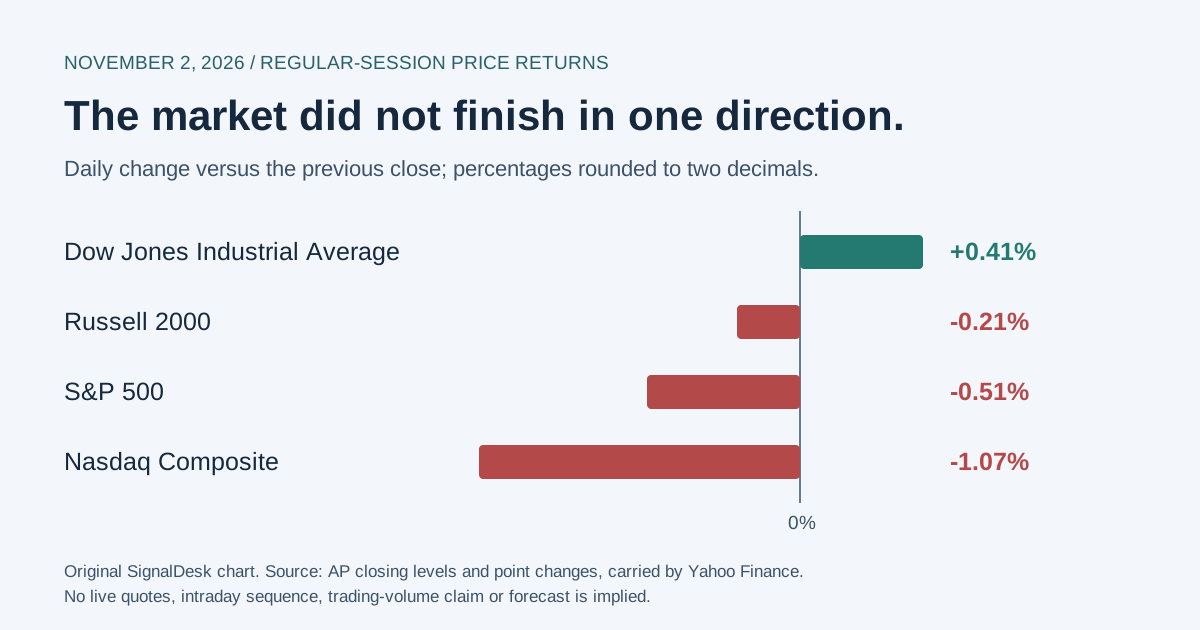
CNBC's closing report and the AP index recap carried by Yahoo Finance agree on the major closing levels:
- S&P 500: 7,541.40, down 38.67 points, approximately 0.51%.
- Nasdaq Composite: 25,164.32, down 272.68 points, approximately 1.07%.
- Dow Jones Industrial Average: 51,983.98, up 213.67 points, approximately 0.41%.
- Russell 2000: 2,805.88, down 5.97 points, approximately 0.21%.
The percentages above are rounded to two decimals from the reported closing levels and point changes. AP rounds its displayed daily percentages to one decimal. These refer to the named indexes, not ETF substitutes such as SPY, QQQ or IWM.
CNBC reports that the S&P 500 had been up as much as 1.1% and the Nasdaq as much as 1.4%. Comparing those rounded positive observations with the negative closes gives approximate swings of 1.61 and 2.47 percentage points, respectively. Those are changes between returns measured against the previous close, not exact high-to-close percentage losses or a timestamped intraday chart.
Why stocks gained first: relief from the oil shock
CNBC reports that Brent crude fell 7.63% to $104.77 a barrel and West Texas Intermediate futures settled down 7.36% at $96.46. Its report links the move to hopes for renewed U.S.-Iran peace talks. AP likewise identifies the sharp Brent decline as a benefit for much of the stock market.
The economic mechanism is straightforward, although not guaranteed: sustained lower oil prices can ease fuel and transport costs, reduce pressure on household spending and improve the inflation outlook. That gives investors a reason to reconsider businesses hurt by expensive energy. It is not evidence that a peace agreement had been completed or that inflation had already fallen.
This also creates winners and losers. Fuel users may benefit, while energy producers can face lower expected realized prices. A fall in crude is therefore not an automatic positive for every sector or every index.
Coming after the prior week's technology sell-off, the opening rebound was also consistent with investors testing whether beaten-down shares could stabilize. Calling it proven short covering or a wave of new institutional buying would require flow data not established by the reviewed sources.
Why the rally failed: cheaper oil did not settle the AI cash-flow debate
The main closing accounts describe continued selling in technology and AI-related stocks. Investors were still confronting the gap between large infrastructure commitments and the timing of the cash flows expected to justify them.
Oracle illustrates that tension. In CNBC's separate November 2 report, the company filed plans for $10 billion of common stock and $10 billion of senior notes, and its shares fell 8.8%. The report also says the funding had already been outlined at the preceding investor day. It would therefore be misleading to describe all of it as an entirely unexpected funding surprise.
The interpretation is about financing economics, not simply whether AI demand exists. More equity can dilute existing ownership; more debt creates interest and repayment obligations. Strong long-term revenue ambitions do not automatically remove those costs or establish a near-term return on invested capital.
CNBC also reports sharp declines in Marvell and Lumentum following their announced combination. Its deal coverage describes an all-stock, fixed-ratio transaction with a headline implied enterprise value of $115 billion. That figure is not cash paid to shareholders, and the implied value moves with Marvell's share price. The companies presented the deal as an AI-connectivity opportunity, but their stocks still sold off.
These examples help explain why cheaper energy was insufficient to rescue technology sentiment. They do not prove that either announcement alone caused the entire index reversal. The reviewed reports also show weakness in Nvidia, Meta and Apple, spreading the pressure across influential names.
Why the Dow could rise while the S&P and Nasdaq fell
The phrase the market fell hides an important distinction. AP reports that a majority of stocks advanced even as the S&P 500 declined. CNBC identifies gains in companies including Sherwin-Williams, Home Depot, Honeywell, 3M and Boeing as support for the Dow.
The S&P 500 is capitalization-weighted: moves in its largest companies have more influence than equal-sized moves in smaller constituents. The Nasdaq Composite is also capitalization-weighted and has substantial technology exposure. A sufficiently large decline in major technology names can outweigh gains in many other shares.
The Dow is price-weighted and has a different membership mix. It need not follow the S&P 500 or Nasdaq on a day when their biggest influences diverge. The Russell 2000's small decline adds another caution: this was not a uniformly strong rally outside technology either.
The most useful description is mixed performance with significant technology weakness, rather than either a universal crash or a healthy recovery in every part of the market. No exact exchange-wide advance-decline ratio is asserted here. We have not independently verified a matching official constituent-breadth file.
Was weak economic data the reason?
Not a simple across-the-board growth scare. CNBC reports that October's ISM manufacturing index rose one point to 55.5, compared with a Dow Jones consensus estimate of 54.5. That is an expansionary reading above 50, not evidence that manufacturing entered contraction in October.
The same live report notes a 1.9% monthly decline in September construction spending, illustrating that the economic releases did not all point in the same direction. Survey manufacturing activity and construction spending measure different things and should not be blended into a single invented growth verdict.
These data provide context, but their publication alongside the reversal does not prove they caused it. The clearest repeated explanation in the closing accounts is technology selling against an otherwise mixed market. This article relies on the cited reporting for the economic releases and does not claim a separate review of the full underlying statistical reports.
What the election did, and did not, explain
Monday was the last regular session before the November 3 U.S. midterm elections. Uncertainty around policy, spending and the future composition of Congress was a reasonable risk-management backdrop. Investors also faced continuing corporate earnings and economic releases.
But election uncertainty is not a precise explanation for every intraday change. No election result was known from Tuesday's voting during Monday's cash session, and the reviewed sources do not establish that one poll, positioning adjustment or political headline triggered the reversal. Presenting the move as proof that the market had already priced a particular election result would overstate the evidence.
Chronology matters for earnings too. Apple and Palantir reported after the November 2 closing bell. Anticipation of results may have influenced trading beforehand, but the eventual releases cannot be the cause of an already-completed regular-session decline. This recap does not mix their later trading reactions into Monday's index closes.
The simplest explanation
The early rally reflected relief that one major cost pressure might ease; the later decline reflected unresolved concerns about another set of risks. Oil-price relief supported many businesses, while AI investment requirements, funding economics and weakness in large technology shares weighed on the indexes most exposed to them.
That combination explains the apparent contradiction: many stocks could rise while the most-watched growth benchmarks fell. It is a supported synthesis of the reporting, not a claim that every investor traded for the same reason or that the exact turning point has been independently reconstructed.
What would show that the next bounce is more durable?
- Participation and leadership: Do technology leaders stabilize while strength elsewhere persists, or does one group keep cancelling out the other?
- Closing follow-through: Can indexes retain gains into the close and across subsequent sessions, rather than producing only a sharp opening bounce?
- AI financing and returns: Do new commitments improve the path to cash generation on understandable dilution and debt terms?
- Oil and policy developments: Do diplomatic hopes become durable changes, rather than temporary headline relief?
- Clean event timing: Are price moves being compared within the same trading session and against the correct release times?
None of those checks guarantees a rally. A single reversal is not enough to establish the next market direction, and a lower price alone does not establish value.
Sources and limitations
- CNBC: November 2 closing report and live session updates. The URL reflects the live blog's November 1 start; the cited closing coverage is for Monday, November 2. Provides index closes, reported early gains, oil settlements, company moves and economic-release reporting.
- AP: How major U.S. stock indexes fared Monday, November 2, carried by Yahoo Finance. Corroborates index closes, the S&P's reversal and the distinction between index performance and the majority of stocks.
- CNBC: Oracle's stock and bond funding plans. Separates the filing from the earlier investor-day funding outline.
- CNBC: Marvell and Lumentum's proposed combination. Explains the fixed-ratio all-stock structure and the distinction between implied enterprise value and cash.
These are secondary reporting sources, not a complete exchange trade record or an independent review of the companies' full legal filings. The exact intraday reversal time, order flows and individual traders' motives have not been established. No current November 3 quote, election outcome, short-covering statistic or forecast is asserted. Volatility and risk labels are editorial cautions, not measured predictions. Educational commentary only; not personalized investment advice or a promise of returns.
Connect the research
For the longer-running distinction between rising AI demand and cash available to investors, read Big Tech Is Growing. Why Are the Stocks Falling? Follow the AI Cash Bill. That article retains its own research and reporting dates.
For a company-level illustration of why infrastructure promises need effective contracts and funding, see Fermi Inc. at $2.21: The AI Power Opportunity Meets a Lease and Financing Test.
What would change your view?
Which would make the next rebound more convincing: stronger market participation, stabilized technology leaders or better evidence of AI cash generation? Add a dated source and distinguish what it proves from what remains an assumption.