
At $2.21, Fermi Inc. can look like an inexpensive way to invest in the electricity bottleneck behind artificial intelligence. But a low share price is not the same as a low valuation, and a large development pipeline is not the same as operating cash flow. The central question is whether Project Matador can become a financed, functioning business on terms that reward common shareholders.
Research date: November 3, 2026. Price reference: US$2.21, supplied by the reader. The price has not been independently verified or assigned an exchange timestamp, trading session, bid-ask spread or volume. This is not a live quote or an explanation of a particular price move. Company statements below are attributed to dated releases; calculations and interpretation are identified separately.
Key takeaways
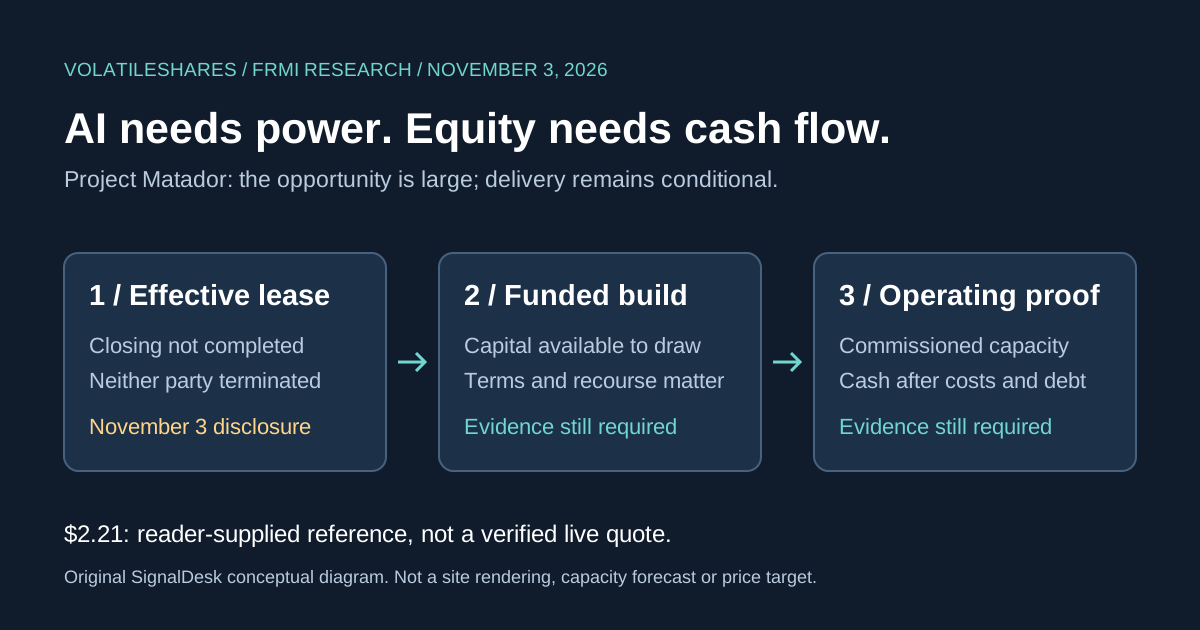
- The anchor lease has not become effective. Fermi's November 3 announcement says closing conditions were not fully satisfied by October 31. Neither party has exercised a termination right.
- AMD credit support is progress, not completed project financing. Its October agreement does not by itself establish that the TensorWave lease has closed or that construction funding is available to draw.
- The $6.5 billion headline is expected revenue over 15 years. It is not current annual sales, profit, collected cash or equity value.
- Historical liquidity must be dated. June cash figures precede July convertible financing and subsequent construction spending; they do not establish November cash or runway.
- The investment case is milestone-dependent. Effective contracts, funded construction and operating delivery matter more than the nominal share price or the ultimate gigawatt ambition.
What investors are actually buying
Fermi Inc., operating as Fermi America and listed under FRMI on Nasdaq and the London Stock Exchange, is developing Project Matador in the Texas Panhandle. The concept combines a private power grid with infrastructure for AI and advanced computing. It is an infrastructure-development investment, not ownership of AMD, TensorWave or a diversified portfolio of established data-center operators.
The company describes a potential campus integrating natural gas generation, utility power, nuclear generation, solar and battery storage. Its releases describe an eventual approximately 17-gigawatt ambition, subject to commercial commitments and development. That is not commissioned capacity or a statement that all technologies have been funded, permitted and delivered. In particular, long-term nuclear ambitions should not be treated as evidence of near-term operating supply.
The commercial logic is credible: customers need reliable electricity and usable sites, while conventional grid access and equipment procurement can take time. Fermi aims to assemble those inputs into a faster route to deployment. The equity risk is whether that advantage can be converted into enforceable customer commitments, financeable projects and cash flows after construction and financing costs.
November 3: signed does not yet mean effective
The most important current evidence is Fermi's November 3 lease update. It states that the October 31 closing date passed without extension and that the Data Center Lease and Services Agreement between Fermi Campus 1 LLC and TensorWave TEX1, LLC has not yet become effective because its closing conditions were not fully satisfied.
Fermi also says neither party has exercised any right to terminate, and both remain committed to completing the transaction. That is materially different from either a completed closing or a terminated agreement. Continued discussions preserve an opportunity; they do not establish when, or whether, closing will occur.
The release lists conditions involving work letters and guaranties, operating schedules and a service-level agreement, board approvals, and project-level financing sufficient to construct the leased premises. It does not identify precisely which individual conditions remain outstanding. We should not assume that every listed item remains unresolved, or that financing is the sole obstacle.
This follows the September 22 amendment, which moved the closing date from September 30 to October 31 while guaranty discussions continued. The relevant next milestone is confirmation of effectiveness and the resulting obligations, not another repetition of the original contract headline.
The TensorWave opportunity: meaningful scale, conditional economics
In its August 13 results release, Fermi described a signed 15-year turnkey lease with TensorWave covering 222 megawatts of total facility power, with approximately $6.5 billion of expected revenue over the contract's life. The company also described two expansion options.
Illustrative calculation: $6.5 billion divided by 15 years is approximately $433 million a year as a simple arithmetic average. This is not annual revenue guidance. It assumes an even distribution solely to explain the scale; actual timing, escalation, delivery, service obligations and recognition could differ. The November 3 effectiveness issue remains central to any assessment of those prospective revenues.
Even if the lease closes, revenue must cover electricity, operations, maintenance and other obligations before producing a return. Construction spending, interest, taxes and any project partners' participation further affect cash available to Fermi's shareholders. The contract headline cannot be used directly as profit, net present value or a price target.
Likewise, an expansion option is not a funded order. Readers should distinguish the initial 222 MW lease from possible later expansion and from the much larger campus ambition.
AMD: a useful financing milestone, not a blanket guarantee
Fermi's October 13 announcement reports a signed credit support agreement with AMD supporting the first-phase lease, alongside a partnership framework for potential expansion to as much as 650 MW of gross power capacity.
This matters because credible credit support can improve a project's attractiveness to lenders. However, the release explicitly describes the agreement as a milestone toward securing financing. Its risk disclosures include conditions to AMD's obligations and to the TensorWave lease closing.
The announcement does not publish enough detail to establish a dollar amount, unconditional coverage of every tenant obligation, or funding of the entire campus. It is therefore inappropriate to describe AMD as guaranteeing Fermi's equity value or eliminating financing risk. The later November 3 statement confirms that the lease still had not become effective despite the October credit-support announcement.
What the financial record establishes
The August 13 release includes unaudited financial statements and reports the following historical figures:
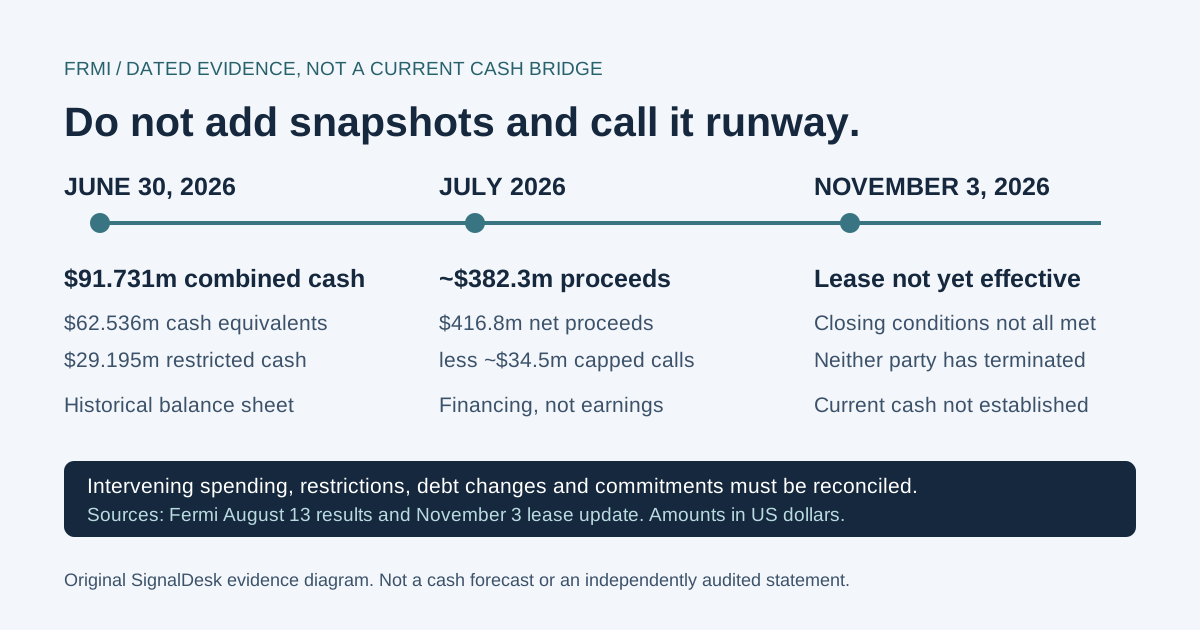
- June 30, 2026 cash and cash equivalents: $62.536 million.
- June 30 restricted cash: $29.195 million, bringing combined cash and restricted cash to $91.731 million. Restricted cash should not automatically be treated as available for general corporate spending.
- June 30 debt, net: approximately $520.1 million, before the subsequent July convertible issuance.
- Second-quarter net loss: approximately $25.8 million, with $26.8 million of general and administrative expense. The release describes Fermi as pre-revenue at that reporting date.
- First-half operating cash outflow: approximately $56.0 million; first-half investments in property, plant and equipment were approximately $626.2 million. These are six-month figures, not second-quarter figures.
Operating cash outflow and property investment together were approximately $682.2 million in the first half, using the reported statement figures. This calculated sum illustrates the importance of construction funding, not a forecast of the next six months' spending. Historical capital expenditure can be highly uneven, and net loss is not a substitute for cash flow.
The company also reported more than $431 million of 5% convertible senior notes due 2031 issued in July. Reported net proceeds were $416.8 million before approximately $34.5 million spent on capped-call transactions, leaving approximately $382.3 million after that stated cost. This is a financing-proceeds calculation, not November cash.
The initial conversion price was approximately $9.52, with capped calls carrying a $14.64 cap. Those arrangements can mitigate certain conversion-related dilution under their terms, but they do not cancel the debt, eliminate refinancing risk or prevent dilution from other securities or future fundraising. A reference price below the initial conversion price does not make the financing free.
What remains unverified: November unrestricted cash, subsequent cash commitments, current debt balances, current fully diluted shares and a comprehensive remaining construction budget. Adding June cash to July proceeds while ignoring intervening spending would not provide a reliable current liquidity figure. We do not calculate a cash runway or a current enterprise value from mismatched dates.
Is $2.21 actually cheap?
A share price needs a share count before it can support a valuation discussion. The June financial statements show approximately 638.1 million common shares outstanding at June 30.
Multiplying that historical share count by the reader's $2.21 reference gives approximately $1.41 billion of illustrative equity value. This deliberately combines a dated share count with an unverified price solely to show why a low-dollar share price does not imply a tiny company valuation. It is not a verified November market capitalization or a fully diluted valuation.
A serious valuation would need an updated share count, current net debt, remaining capital requirements, customer economics, project ownership and credible operating assumptions. Fermi's roughly $1.55 billion gross property, plant and equipment balance at June 30 is not an independent appraisal or a liquidation-value floor. Specialized development assets may require substantial additional spending before producing cash.
A precise price target would imply more certainty than the reviewed evidence supports. The better question is what common shareholders will own, and owe, after each phase is financed and delivered.
A more capital-efficient model still has a cost
In his October 21 shareholder letter, CEO Lee McIntire described prioritizing powered-land transactions, seeking earlier customer contributions and pursuing project-level debt and strategic investment partners. The aim is to manage Fermi's equity requirements and limit corporate financial obligations where feasible.
That could improve financing efficiency compared with Fermi independently funding every turnkey building. But a strategy is not a closed funding package. Outside capital may require collateral, contractual protections, a preferred return or a share of project economics. Lower upfront spending does not automatically mean unchanged long-term profits for common shareholders.
The August release also describes the Hillcore framework for approximately 2.6 GW of additional generation, with Hillcore and its partners funding and owning the plant. Fermi says it would commit no capital and issue no debt for that plant, but would act as anchor offtaker under a 20-year power-purchase agreement. Avoiding plant-construction debt is not the same as avoiding all future payment obligations. The ultimate economics depend on contracted demand and the operative agreements.
Bull, middle and bear cases: evidence, not price predictions
Bull case: The TensorWave lease becomes effective, sufficient construction financing closes on sustainable terms, and Fermi delivers reliable power and facilities. Additional customers then validate a repeatable, more capital-efficient model. The evidence would be effective agreements, committed and drawable funding, commissioning milestones and customer cash receipts.
Middle case: Discussions continue and development progresses, but closing or delivery takes longer. Fermi remains dependent on financing while shareholders wait for operating proof. A financing extension might buy time without resolving the ultimate return on invested capital.
Bear case: Closing fails, counterparties withdraw, funding becomes unavailable or expensive, or construction exceeds budget and schedule. Equity holders could face dilution, reduced project participation, asset impairments or substantial loss. An unfinished infrastructure asset and a large addressable market do not protect the common share price.
These are analytical scenarios, not assigned probabilities, forecasts or trading signals. The reviewed disclosures do not support claiming a guaranteed recovery or attributing a stock move to one event.
What to watch next
- Lease effectiveness: Which closing conditions have been satisfied or waived, and what obligations now bind each party?
- Financing completion: Who provides the capital, what can actually be drawn, and what recourse, security and equity participation are required?
- Updated liquidity and commitments: Unrestricted versus restricted cash, debt changes, committed construction costs and further funding needs.
- Delivery evidence: Construction progress, commissioning, fuel and utility readiness, acceptance tests and contractual service dates. Delivered equipment is not the same as operating capacity.
- Shareholder economics: Updated diluted capitalization, project-level ownership, recurring margins and cash after financing costs.
Bottom line
Fermi has a potentially valuable proposition at the intersection of AI infrastructure and reliable power. But at the supplied $2.21 reference, this remains a speculative development-and-financing thesis, not a demonstrated bargain based on operating earnings.
The November 3 distinction is decisive: the TensorWave lease is not yet effective, but it has not been terminated. AMD support and management's financing strategy improve the range of possible outcomes; they do not establish that the necessary capital and cash flows are already secured. The investment case strengthens with completed milestones and transparent shareholder economics, not simply with a lower share price.
Sources and limitations
- Fermi company statement, November 3, 2026: Lease status after the October 31 closing deadline.
- Fermi company release, September 22, 2026: Closing-date amendment and lease conditions.
- Fermi company release, October 13, 2026: AMD credit support and expansion framework.
- Fermi shareholder letter, October 21, 2026: Financing strategy.
- Fermi company release, August 13, 2026: Second-quarter results, financial statements, convertible financing and Hillcore framework.
- Follow-up filing source: SEC EDGAR company page, CIK 2071778.
The substantive sources above were read as company-issued releases distributed through ACCESS Newswire. Direct investor-relations pages and SEC document access were blocked during this research; this article does not claim an independent review of the complete filed agreements or a comprehensive search of all subsequent filings. Company descriptions and projections are not independently verified engineering, legal or credit opinions. Financial figures retain their original reporting dates. High-volatility and speculative-risk labels are editorial cautions, not measured volatility statistics. Educational research only; not personalized investment advice or a promise of returns.
Connect the research
For the distinction between an infrastructure developer, a landlord and an AI-cloud operator, compare Data Center Stocks: A Small-, Mid- and Large-Cap Guide to Power, Profits and Funding Risk. That article retains its own research and reporting dates.
What would change your view?
Which would matter most to your FRMI thesis: an effective tenant lease, committed project financing or first operating cash receipts? Add a dated source and explain how it changes the risk assessment, or continue in the $FRMI Stock Room. Challenge the evidence and assumptions, not other readers.