
The ticker looks like a shortcut to the AI boom. The business is anything but a shortcut. For GPUS, the useful question is how much funded, customer-backed infrastructure can become cash for each shareholder, not how much excitement surrounds graphics processors.
Reading note: Presentation refreshed October 30, 2026. Original publication: 2026-10-13 (UTC). Figures, targets and company claims retain their original evidence dates; this is not a new verification or a live-price update.
Key takeaways
- Know what you own. GPUS is Hyperscale Data, not a basket of leading GPU manufacturers.
- Separate capacity from cash. A power commitment or planned deployment is not recognized customer revenue.
- Read both sides of growth. Reported sales and gross-profit progress coexist with operating losses and financing needs.
- Count the shares. Issuance, business complexity and Bitcoin exposure can change the per-share outcome.
Ticker GPUS belongs to Hyperscale Data, Inc., a NYSE American-listed operating company. Despite the ticker, buying GPUS is not the same as buying a diversified basket of leading graphics-processor manufacturers. The investment case depends on one small company's ability to finance, build, and operate digital infrastructure while managing several other business interests.
What the company is trying to build
Hyperscale Data presents AI-capable data-center infrastructure as a central part of its strategy. That gives the shares a connection to demand for compute-intensive workloads, but the connection is indirect: results depend on facilities, power access, customer contracts, capital availability, and operating execution rather than GPU unit sales alone.
The company has also reported exposure to Bitcoin mining and other activities. Investors should therefore treat GPUS as a multi-factor, speculative operating-company investment—not as a pure-play GPU manufacturer and not as an index fund.
The potential bull case
- Demand for AI compute and data-center capacity may support well-positioned infrastructure operators.
- Existing sites, power arrangements, or hosting capabilities could become more valuable if customer demand converts into contracted revenue.
- A successful shift toward higher-quality recurring infrastructure revenue could improve the clarity of the business.
- Small companies can react sharply when financing, customer, asset-sale, or operating milestones materially improve expectations.
The risks that matter most
- Financing and dilution: data centers require substantial capital, and issuing additional shares can reduce each existing shareholder's ownership percentage.
- Execution: plans and capacity announcements do not guarantee completed facilities, signed customers, utilization, revenue, or positive cash flow.
- Business complexity: multiple operating activities can make the underlying economics harder to evaluate.
- Bitcoin sensitivity: mining economics and digital-asset holdings can introduce volatility unrelated to AI infrastructure demand.
- Small-cap trading risk: limited liquidity, wide spreads, reverse splits, and sharp price moves can amplify losses.
- Competitive pressure: larger data-center, cloud, and infrastructure companies may have cheaper capital, stronger customer relationships, and greater scale.
Bull case by the numbers
$78.9M
Six-month revenueReported for the six months ended 30 June 2026, up about 55% from $50.9M in the prior-year period.
$23.9M
Six-month gross profitMore than double the prior-year $11.4M, showing improved gross-profit contribution across the combined businesses.
20 MW
AI colocation commitmentThe customer agreement covers about two-thirds of the Michigan facility's approximately 30 MW of currently available power. Deployment is planned in phases and is not the same as recognized revenue.
Bear case by the numbers
$44.4M
Six-month operating lossLoss from operations was about 2.7 times the prior-year $16.5M loss, so revenue growth had not translated into operating profitability.
$36.8M / $243.5M
Cash versus liabilitiesAt 30 June 2026, reported liabilities were about 6.6 times cash and cash equivalents. Liabilities are not the same as debt, but the comparison shows the balance-sheet burden.
121.8M shares
ATM issuance through 9 OctoberThe company reported $49.8M of gross proceeds from shares sold under the ATM program, with another $50.2M of gross issuance capacity remaining under the amended $100M program.
These figures are reported evidence, not forecasts. Revenue growth and contracted power support the bull case only if deployment produces durable cash generation. Operating losses, the balance-sheet burden, and additional issuance capacity support the bear case because execution may require more capital and dilute existing holders.
Figure sources: Hyperscale Data Form 10-Q for the quarter ended 30 June 2026, filed 19 August 2026 (SEC accession 0001214659-26-010549), and the Form 424B5 prospectus supplement filed 13 October 2026 (SEC accession 0001214659-26-012770).
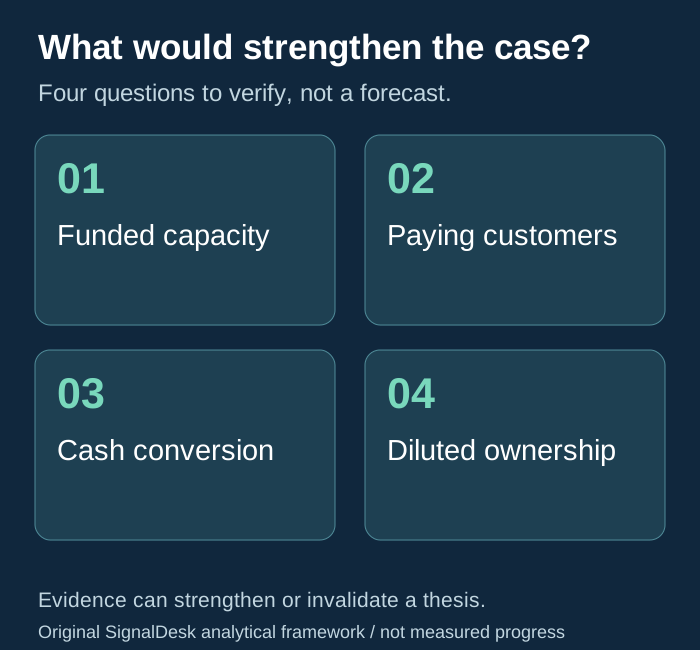
What to verify before considering the shares
Read the latest Form 10-K, Form 10-Q, and subsequent Form 8-K filings on SEC EDGAR. Compare management's claims with reported revenue, operating cash flow, cash on hand, debt, share count, and contractual commitments.
Track the fully diluted share count rather than the headline stock price alone. Review any at-the-market program, warrants, preferred securities, convertible instruments, or reverse-split history. For announced data-center projects, distinguish planned megawatts from energized capacity and signed, revenue-producing customer deployments.
A practical watchlist
- Quarterly revenue and operating cash flow by business line
- Cash balance, debt maturities, and capital-spending requirements
- Basic and diluted weighted-average shares outstanding
- Announced versus completed data-center capacity
- Signed customer contracts and disclosed utilization
- Bitcoin production, holdings, and mining economics
- Related-party transactions and changes in corporate structure
Bottom line
GPUS offers a high-risk way to follow a small company's attempt to participate in AI infrastructure and other volatile markets. The ticker should not be mistaken for direct ownership of GPU leaders. A credible thesis needs evidence of funded construction, contracted demand, improving cash generation, and controlled dilution. Until those elements are visible in primary filings, GPUS is best approached as a speculative watchlist candidate rather than a simple bet on broad GPU demand.
Sources to verify: Hyperscale Data investor materials and the company's filings on SEC EDGAR (CIK 0000896493). Company strategy and capital structure can change quickly, so use the latest filings rather than relying on this overview alone.
Source links for independent verification
These links are provided so readers can inspect the sources; adding them does not certify the figures above. Review subsequent filings and check whether earlier statements are still current.
- Company investor materials: https://hyperscaledata.com/press-releases
- SEC filings for CIK 896493: https://www.sec.gov/edgar/browse/?CIK=896493&owner=exclude
- Form 10-Q accession cited above: https://www.sec.gov/Archives/edgar/data/896493/000121465926010549/
- Prospectus supplement accession cited above: https://www.sec.gov/Archives/edgar/data/896493/000121465926012770/
Connect the research
To see why a landlord, an AI-cloud operator and a supplier are different investments, compare Data Center Stocks: A Small-, Mid- and Large-Cap Guide to Power, Profits and Funding Risk. It retains its own research and reporting dates.
For another development-stage example, with different assets and obligations, read Can NUAI Follow the Data-Center Leaders? Ambitions, Milestones and Similar Stocks. It retains its own research and reporting dates.
What would change your view?
Which would change your GPUS view most: a funded deployment, recurring customer cash or a clearer dilution picture? Add your reasoning and a dated source in the article discussion below, or continue in the $GPUS Stock Room. Challenge the evidence and assumptions, not other readers.
Presentation-only refresh: original sources, dated figures, forecast caveats and disclosure statements are retained. The new illustrations explain the analytical questions; they are not current-price charts or forecasts.