
A transaction can put a number on a business without putting that amount in the parent's bank account. That is the distinction at the heart of FFAI's robotics proposal: the ownership received, restrictions attached and funding still needed matter as much as the announced valuation.
Reading note: Presentation refreshed October 30, 2026. Original publication: 2026-10-14 (UTC). Figures, targets and company claims retain their original evidence dates; this is not a new verification or a live-price update.

Key takeaways
- A reference value is not proceeds. The agreed robotics valuation is not a cash windfall or a stock-price target.
- The securities are distinct. Proposed participation through FFR does not make FFAI and FFR interchangeable.
- Read the final mechanism. The earlier special-dividend concept was removed from the definitive structure described here.
- Closing and liquidity remain tests. Lockups, final capitalization and parent obligations affect any benefit to current holders.
Research note prepared for October 14, 2026. Faraday Future Intelligent Electric Inc. trades on Nasdaq as FFAI. Its October 14 company announcement describes definitive agreements for FF EAI Robotics Ecosystem Inc. (Nasdaq: FFR) to acquire FFAI's robotics ecosystem business at an agreed valuation of approximately $200 million. This is a transaction to investigate, not evidence that $200 million of cash has arrived at FFAI or that the shares are worth a particular price.
What changed today
The parties moved from a non-binding term sheet to definitive agreements. The company says the structure has been simplified and that the special stock dividend contemplated in the earlier term sheet is no longer part of the definitive transaction. Investors should therefore not assume that purchasing FFAI now entitles them to a separate distribution of FFR shares under the abandoned mechanism.
The release says closing is expected by the end of October. Expected timing is not a completed closing. Retaining key personnel, final transaction terms, capitalization, and other conditions still need to be checked in the agreements and subsequent SEC filings.
What FFAI shareholders would own indirectly
Under the release's estimated as-converted, fully diluted capitalization, FFAI would hold approximately 65.7% of FFR after closing. Newly issued shares received by FFAI would carry an 18-month lockup. FFAI would therefore participate through its proposed controlling investment in FFR, rather than receive an immediately liquid cash payout for the headline deal value.
FFAI also describes a planned shift toward a robotaxi sharing network and AI cabin technology operator. That is management's intended operating model, not proof of a profitable shared-mobility business. FFAI and FFR remain distinct securities: the parent's obligations and other operations matter when evaluating FFAI.
Constructive evidence
About $200M
Agreed robotics-business valuationA negotiated transaction reference point, not cash proceeds, independently proven fair value, or a price target for FFAI.
About 65.7%
Proposed FFAI ownership of FFREstimated post-closing ownership on an as-converted, fully diluted basis; final capitalization may change.
Up to $10M
FFR first-round PIPE financingThe release describes financing at market without warrants; this concerns FFR and should not be counted automatically as unrestricted FFAI cash.
A dedicated listed platform could make robotics performance easier to assess. The thesis improves only if the transaction closes, reporting becomes clearer, customers pay for products and services, and financing supports operations without excessive dilution.
The counterweight
18 months
Lockup on shares received by FFAIProposed ownership does not imply immediate ability to monetize the investment.
$7M / $45M
Standalone robotics revenue projectionsManagement's preliminary projections for 2026 and 2027, not reported revenue and not guidance adopted by FFR.
Q3 2028
Projected positive operating cash flowA management scenario for the robotics business, not a promise that either listed issuer will be self-funding before then.
The release's risk discussion explicitly flags FFAI's liquidity, going-concern position, ability to pay outstanding obligations, funding availability, and the risk that the transaction may not close. A proposed subsidiary valuation does not erase the parent's liabilities or near-term financing requirements.
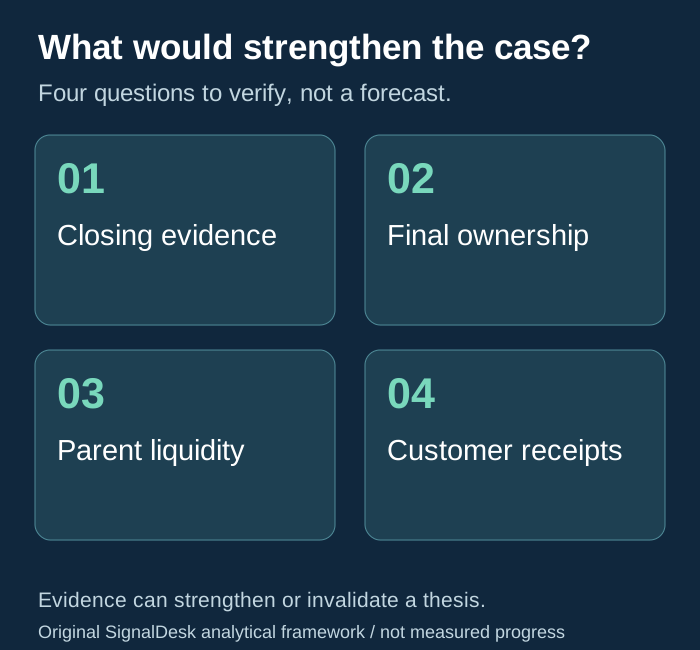
What to verify next
- A closing announcement and the final SEC-filed transaction documents
- Final ownership, exchange terms, lockups, voting arrangements, and related-party disclosures
- Parent-company cash, debt, payable obligations, share count, and convertible instruments
- Actual robotics revenue, cash receipts, gross margin, and customer concentration versus projections
- How much additional capital each issuer requires and who bears that dilution
- Concrete operating economics for the proposed robotaxi and AI cabin strategy
Bottom line
FFAI is a speculative corporate-restructuring watch, not a simple way to purchase $200 million of robotics assets at a discount. The constructive case is a clearer operating platform and continuing majority participation. The opposing case is that transaction execution, locked-up ownership, parent-company liquidity, and additional financing consume or delay the expected benefits. Let the closing documents and cash-flow evidence test the story.
Sources and evidence date
Evidence reviewed October 14, 2026. Today's transaction details come from Faraday Future's October 14 Business Wire announcement, reproduced by Yahoo Finance: https://finance.yahoo.com/technology/ai/articles/faraday-future-announces-signed-definitive-113000109.html
Official investor relations and subsequent filings: https://investors.ffai.com/ and https://investors.ffai.com/sec-filings/
The small/micro-cap label follows the portal's delayed October 14 snapshot and is not a live valuation. Extreme-volatility and speculative-risk labels are editorial cautions, not measured forecasts. This note does not assert a same-day price move, a completed sale, or a guaranteed return. Educational commentary only; not personalized investment advice.
Connect the research
A different transaction illustrates the same distinction between proposed equity rights and collected cash: DVLT Stock: DataMEDS LOI Offers Healthcare Upside, but Deal Economics Remain Unproven. It retains its own research and reporting dates.
For a separately dated example of why post-deal capitalization matters, compare SKYD Stock: Malone's Netflix Claim, Warner Deal Economics and Analyst Forecasts. It retains its own research and reporting dates.
What would change your view?
Which final document would you check first: the closing terms, diluted ownership or the parent's cash obligations? Add your reasoning and a dated source in the article discussion below, or continue in the $FFAI Stock Room. Challenge the evidence and assumptions, not other readers.
Presentation-only refresh: original sources, dated figures, forecast caveats and disclosure statements are retained. The new illustrations explain the analytical questions; they are not current-price charts or forecasts.