
An encouraging short study earns a company more questions, not a finished investment case. BMEA's next challenge is to show that an early clinical signal can hold up in larger, longer research while the balance sheet supports the work needed to find out.
Reading note: Presentation refreshed October 30, 2026. Original publication: 2026-10-15 (UTC). Figures, targets and company claims retain their original evidence dates; this is not a new verification or a live-price update.
Key takeaways
- Phase 1 is early. Short follow-up and small cohorts cannot establish durable clinical or commercial success.
- Read the study design. Population, endpoints, placebo results and cohort conditions shape what the findings mean.
- Pipeline dates are targets. Later studies and reported readouts must be checked against updated disclosures.
- Terminated financing adds no cash. Avoiding one offering does not remove future funding or dilution risk.
Research note prepared October 15, 2026. Biomea Fusion, Inc. (Nasdaq: BMEA) is a clinical-stage biotechnology company developing oral small-molecule therapies for diabetes and obesity. Its pipeline includes the investigational oral GLP-1 receptor agonist BMF-650 and icovamenib, a covalent menin inhibitor being studied in metabolic disease. The company has no approved product described in the evidence reviewed here, so the investment case depends on clinical results, regulatory progress, and continued financing.
What the latest BMF-650 data show
On October 13, Biomea reported results from its randomized, double-blind, placebo-controlled Phase 1 GLP-131 trial in otherwise healthy adults who were overweight or obese. Safety and tolerability were co-primary endpoints; pharmacokinetics, pharmacodynamics, and weight reduction were secondary endpoints.
Across outpatient Cohorts 1 through 4, mean weight reduction at Day 29 ranged from 1.5% to 3.2%, compared with 0.1% for pooled placebo. The company also reported that all treatment-emergent adverse events across the five active-dose multiple-ascending-dose cohorts, covering 40 participants, were mild or moderate. Among BMF-650-treated participants, it reported no severe or serious treatment-emergent adverse events, no dose modifications due to those events, and no related discontinuations.
The highest-dose cohort used 200 mg once daily for one week followed by 400 mg once daily for three weeks. All treatment-emergent adverse events in that cohort were reported as mild, with nausea and vomiting each reported in 12.5% of participants. However, the company said confinement affected eating behavior and that Cohort 5 should be interpreted separately from outpatient Cohorts 1 through 4. That caution matters when assessing the cohort's weight result.
Bull case by the numbers
1.5% to 3.2%
Mean Day 29 weight reductionReported across outpatient Cohorts 1-4, versus 0.1% for pooled placebo.
40 participants
Active-dose safety setAcross five multiple-ascending-dose cohorts, reported adverse events were mild or moderate.
400 mg once daily
Highest target doseReached after one week at 200 mg in Cohort 5, with all reported treatment-emergent adverse events in that cohort classified as mild.
These are early clinical observations, not proof of durable weight loss, competitive efficacy, or regulatory success. The study was short, involved small cohorts, and enrolled otherwise healthy adults rather than a broad real-world patient population.
The broader pipeline can create more than one catalyst
Biomea is also studying icovamenib in diabetes and obesity. In its August 5 second-quarter update, the company said the Phase II COVALENT-211 trial in insulin-deficient type 2 diabetes was targeting 26-week primary-endpoint data in the first quarter of 2027, while COVALENT-212 in people not achieving glycemic targets on GLP-1-based therapy was targeting data in the second quarter of 2027.
Multiple programs can diversify the clinical calendar, but they also increase execution demands. Investors should verify enrollment status, protocol changes, safety findings, and updated timing in each later filing or company release rather than treating an earlier target date as guaranteed.
Financing risk is central to the thesis
At June 30, 2026, Biomea reported $35.2 million of cash, cash equivalents, and restricted cash. It reported a net loss attributable to common stockholders of $8.3 million for the second quarter and $20.7 million for the first six months of 2026. Management's August update projected cash runway into the second quarter of 2027, but runway estimates are forward-looking and depend on spending, trial timing, and financing assumptions.
On September 23, the company terminated a proposed public securities offering after management determined market conditions were not conducive to terms it considered in stockholders' best interests. The company said no securities were sold in that proposed offering. Avoiding an unattractive transaction can protect shareholders from immediate issuance on those terms, but terminating it did not add capital. Future equity, debt, partnership, licensing, or cost-control decisions remain important watchpoints.
Risks that deserve equal weight
- Early evidence: four weeks of Phase 1 data cannot establish long-term efficacy, durability, adherence, or safety.
- Small cohorts: a limited number of participants makes estimates sensitive to individual outcomes and study conditions.
- Comparator limits: cross-trial comparisons with approved injectable or investigational oral obesity medicines can mislead because populations, doses, endpoints, and follow-up differ.
- Development risk: later trials may not reproduce early signals and could reveal new adverse events.
- Financing and dilution: a clinical-stage company may need additional capital before commercialization.
- Regulatory and commercial risk: even positive trials do not guarantee approval, reimbursement, manufacturing scale, or market adoption.
- Pipeline concentration: setbacks in BMF-650 or icovamenib could materially change the valuation narrative.
What to watch next
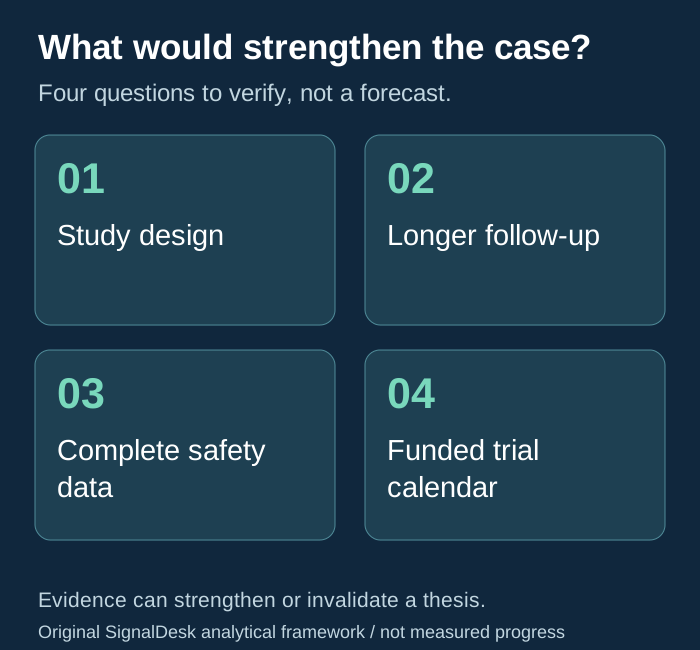
For BMF-650, look for the next trial design, dose selection, participant count, duration, discontinuation rates, placebo-adjusted outcomes, and complete adverse-event tables. For icovamenib, track whether the company delivers the stated 2027 data milestones and whether results show clinically meaningful, durable benefit.
For the balance sheet, compare quarterly operating cash use with unrestricted cash and expected trial spending. Review any new shelf takedown, at-the-market program, strategic collaboration, warrant issuance, or other financing on a fully diluted basis.
Bottom line
Biomea's October BMF-650 update provides a legitimate early research signal: outpatient cohorts showed mean four-week weight reduction above pooled placebo, while the reported short-term tolerability profile supported continued study. It does not yet establish that BMF-650 can match or exceed established obesity therapies over the longer periods that matter clinically and commercially.
BMEA therefore remains a catalyst-driven, speculative biotechnology stock. A stronger thesis requires larger and longer controlled studies, consistent execution across the pipeline, and a financing plan that carries the programs through meaningful readouts without excessive dilution.
Sources and evidence date
Evidence reviewed through October 15, 2026.
Biomea Fusion October 13, 2026 BMF-650 Phase 1 release: https://investors.biomeafusion.com/news-releases/news-release-details/biomea-fusion-announces-phase-1-results-bmf-650-its
SEC Form 8-K filed October 14, 2026, including the BMF-650 presentation and press release: https://www.sec.gov/Archives/edgar/data/1840439/000119312526420684/d158362d8k.htm
Biomea Fusion August 5, 2026 second-quarter results: https://investors.biomeafusion.com/news-releases/news-release-details/biomea-fusion-reports-second-quarter-2026-financial-results-and
SEC Form 10-Q for the quarter ended June 30, 2026: https://www.sec.gov/Archives/edgar/data/1840439/000119312526335085/bmea-20260630.htm
Biomea Fusion September 23, 2026 offering-termination release: https://investors.biomeafusion.com/news-releases/news-release-details/biomea-fusion-announces-termination-proposed-public-offering
Company statements about trial timing, cash runway, clinical potential, and future plans are forward-looking and may change. Educational commentary only; not personalized investment advice.
Connect the research
For a contrast with a company already evaluating commercial-product adoption and settlement payments, read Liquidia Corporation (LQDA): An Early Catch for the Research Watchlist. It retains its own research and reporting dates.
What would change your view?
Which BMEA evidence would you prioritize: longer controlled data, the full safety tables or funding through the next meaningful readout? Add your reasoning and a dated source in the article discussion below, or continue in the $BMEA Stock Room. Challenge the evidence and assumptions, not other readers.
Presentation-only refresh: original sources, dated figures, forecast caveats and disclosure statements are retained. The new illustrations explain the analytical questions; they are not current-price charts or forecasts.